
Making multifamily truly urban
The multifamily industry is building more in walkable locations, but developers still need instruction on the manners of placemaking. Here are some hints.
On Monday, I reported that many more multifamily units are being built on street grids, which offer important amenities to residents. Instead of density attached to a congested arterial road, urban apartments are connected to culture and walkable to shops, parks, and schools.
As the multifamily industry strides forward, challenges arise. Some developers have mastered the craft of building in an urban place and using active frontages. Others are merely plunking down buildings with little change in design from those that previously fronted parking lots.
Most communities still have conventional codes that are oblivious to the things that provide comfort to people on foot or bicycle — outside of their one-ton, four-wheel appendage. These elements include awnings and galleries, active building frontages, buildings that shape the public realm into an “outdoor room,” streetscape elements that provide enclosure and protection, and the screening of parking from the view of people on the street. Form-based codes, on the other hand, pay a lot of attention to these aspects of the public realm that improve livability.
The public realm is rarely talked about — oddly enough, because it comprises everything you see in a community once you step off of your own property or outside of your apartment, or step out of a restaurant or movie theater. It comprises much of what forms an impression on a visitor who might want to vacation, or move to, or start a business in, a particularly community.
When I posted yesterday that the multifamily industry has evolved from suburban “garden” apartments — where the gardens are actually parking lots — to building on urban blocks and streets, architect Thomas Low of Charlotte, North Carolina, responded:
“Across the continent these high-density developments are rapidly dropping into urban locations — in many cases with little regard for how buildings connect to the street and public realm. Many cities with antiquated zoning and out-dated best practices in place are at the mercy of aggressive development speculators and their designers that have other priorities and/or do not understand basic urban design principles. Here is an example of the kind of development many cities are getting:
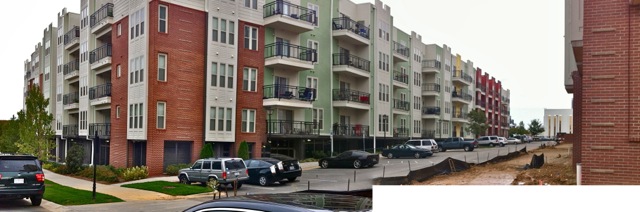
Then Low provided a rendering of the same building, with a few key changes — like entrances on the street, street trees, a corner store, and a better streetscape:
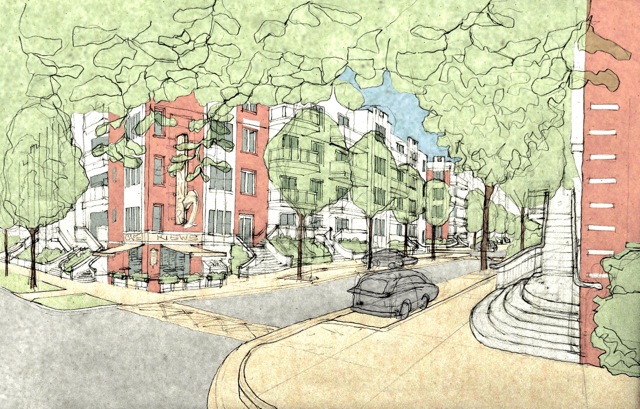
Courtesy of Thomas E. Low, AIA, Civic by Design Forum
Nathan Norris, chief executive officer at the Downtown Development Authority in Lafayette, Louisiana, then posted an illustration “that our office created recently (through the leadership of urban designer Geoff Dyer) that tries to summarize the ‘essential rules’ or key elements for urban character for downtown Lafayette.”

The elements are quite simple, and none are terribly expensive. Half of these are part of the building itself (shown at the top), and the other half aspects to the street (at the bottom). Some are out of control of the developer, including the street designed for speeds below 25 miles per hour. Yet they all add up to a “place,” something that is not achievable in the isolated, conventional suburban model that multifamily developers followed 15 or 20 years ago.
A final note: Not every urban place can be excellent. Urbanists distinguish between “A” streets, where the urbanism is excellent, and “B” streets, which may be functionally walkable, but not ideal. In a form-based code, the standards are tighter for “A” streets. The illustration provided by Norris is meant for “A” streets.
Developers of multifamily buildings have taken the first, big, step by recognizing that urban place outside the building adds to quality of life and value. Achieving true sense of place is not that difficult. Better codes will reward developers that are now seeking urban locations for improving their urban manners.
For more in-depth coverage:
• to Better! Cities & Towns to read all of the articles (print+online) on implementation of greener, stronger, cities and towns.
• Get , packed with more than 800 informative photos, plans, tables, and other illustrations, this book is the best single guide to implementing better cities and towns.
Comments