
A misshapen memorial to President Eisenhower
The monument by Frank Gehry violates the L’Enfant plan and offers “an axis to nowhere.”




Until now, Washington, DC, has managed to keep Frank Gehry from leaving his imprint on the city. However, all signs indicate that his $90 million monument to President Dwight D. Eisenhower may get built.
Unfortunately, the banal design by the star-architect falls short on several levels: architecture, urban design, landscape, and respect for the L’Enfant plan. As a consequence it will fail to inspire or enthuse future generations in the same way that other memorials in the nation’s capital do, such as the Lincoln, Jefferson, and Vietnam War memorials.
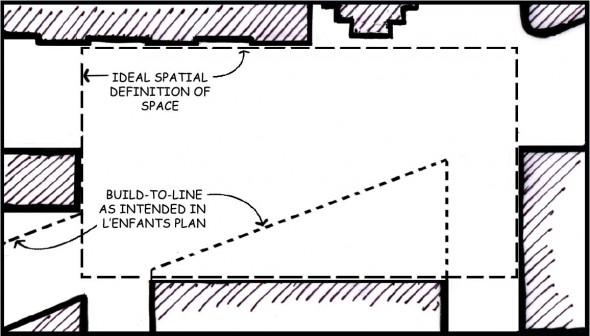
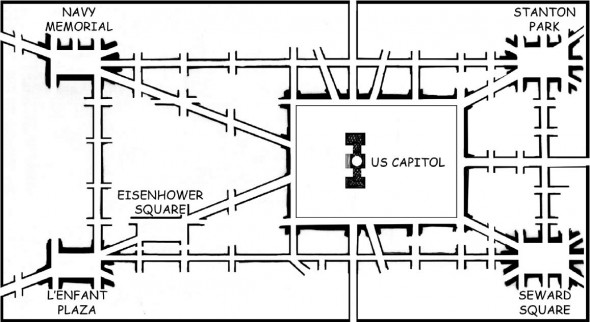
A four-acre site has been selected for the Eisenhower memorial — on Maryland Avenue in Washington’s Southwest quadrant. Maryland Avenue runs southwest from the Capitol and visually terminates at the Jefferson Memorial. It is the symmetrical pair to Pennsylvania Avenue, which runs northwest from the Capitol and terminates at the White House.
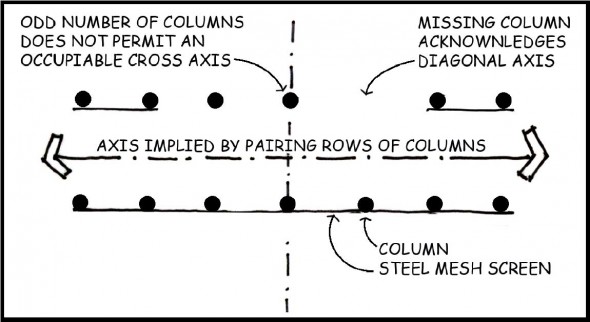
The Eisenhower Memorial Commission and the General Services Administration (GSA) selected Gehry’s design concept in a three-stage competition. The winning scheme primarily consists of two rows of abstract 80-foot-high limestone cylinders (columns) located along the east-west axis of the site. One cylinder is eliminated to recognize the diagonal axis of Maryland Avenue, leaving 13 cylinders instead of 14. Hung between the cylinders are large woven stainless steel-mesh tapestries that depict images and themes of Eisenhower's life. Additionally, massive large stone blocks and a water body are chaotically scattered within the space defined by the cylinders, along with groves of oak trees.
A drive-by experience
In Gehry’s words, his Eisenhower Memorial is a “theatre for the automobile,” which is another way of saying that he is designing a drive-by experience. Hence the tapestries are scaled to be billboards viewed while in motion. Maybe he has forgotten that the site is in the city of Washington, where a large proportion of the residents and visitors are pedestrians. The most beautiful, provocative, and inspiring memorials in the city are experienced on foot.
Gehry’s design intention — to create a defined square within the boundaries of the site — violates the L’Enfant plan, which places 4 symmetrical squares around the Capitol, much like William Penn’s plan for Philadelphia. By striving to create an additional square within this framework, the simplicity, elegance, and intention embodied in the original plan are compromised.
Over the past 220 years, many erroneous modifications have been made to the L’Enfant plan; this practice should not be permitted to continue. History shows that a master plan can be enhanced by appropriate modifications, such as the extension of the Washington Mall by the McMillan Commission. That is only true, however, when the urban design pays homage and respects the original intent — not the case with the Gehry proposal.
Architecturally the use of two parallel rows of columns creates an axis — in this case “an axis to nowhere.” This error is exacerbated by the addition of steel scrim tapestries that connect the rows of columns along the north and south sides, further reinforcing the east-west axis, which is open, thus looking outward at nothing of merit. Lush vegetation is gratuitously incorporated at the two ends to minimize the error.
What Gehry clearly seems enamored with is the use of woven steel-mesh tapestries hung on beams spanning between the columns. The tapestries are to display images of Eisenhower and his presidency. The press informs us that this idea comes from Gehry's “exploration of the tapestry collection at the Philadelphia Museum of Art where he is currently working on an expansion.”
Given the transparent nature of the woven steel-mesh tapestries and the fact that most visitors will approach the memorial from Independence Avenue on the northern edge, it is questionable whether this untested technique will render the images adequately visible in sunlight. Additionally, will the grove of oak trees prohibit viewing the images? It is also interesting to speculate on how the images will be oriented to viewers — for the pedestrian from within the space or for the passenger in an automobile from outside. Maybe it just does not matter today, when images are flipped, rotated, and warped. As a memorial, is this something that is likely to endure the test of time?
As landscape design, the model of the scheme suggests the incorporation of, and reliance on, lush vegetation, predominantly in the form of oak trees. Typologically urban squares are defined by buildings and/or trees along the perimeter, which reinforce spatial quality and enclosure; only a few trees, if any, are located within the space. Gehry’s scheme places an abundance of trees within the space, while leaving just the center free for a single oak tree to serve as a focal point. The reliance on this single tree as a focal point may render the memorial incomplete for many years, until such time as the vegetation grows to the height suggested in his model.
Counterproposal competition
Troubled by the unveiling of the Gehry design, two organizations — the National Civic Art Society (NCAS), an organization dedicated to the betterment of the nation’s civic architecture, monuments, and art, and the Institute for Classical Architecture (ICA) Mid-Atlantic Chapter, which is dedicated to strengthening and furthering the classical building arts — teamed up to sponsor an open counterproposal competition.
The design brief stated:
The memorial should be recognizable as a memorial in the classical idiom appropriate to the dignity of the subject and appropriate to Washington, DC. The memorial should embody the traditions of civic art in Washington, DC, and should stand in harmony with the vision of the L’Enfant Plan and the McMillan Plan.
The use of symbolic content and representation must be considered.
The memorial should be able to speak to future generations without explanation in the form of placards or signs. No limit to the size or extent of the memorial is specified apart from height limits imposed by the District of Columbia building code.
A sculptural representation that is recognizable as Dwight D. Eisenhower and appropriately ordered to the gravity of the memorial and to the dignity of the city as a whole is required.
The jury for the competition was composed of members from the architectural, artistic, and civic communities who are dedicated to the restoration of a classical vision of Washington. Jurors included Joseph Bottum, Bruce Cole, Ronald Lee Fleming, Charles Lancaster, Ambassador J. William Middendorf III, and Michael Curtis (nonvoting jury foreman and NCAS board member).
Outcome
By the deadline this May, more than 40 entries were received from students and architects. The primary lesson that can be drawn from these schemes is that a far better urban-architectural solution exists than the one chosen by Gehry.
The counterproposal designers were influenced by historical models and by a shared understanding of architectural composition and tectonics. For example, throughout history, a common device to coalesce a space that was poorly defined, lacked enclosure, and consisted of undistinguished buildings was the erection of a central object. This object served as the focus and nucleus of the space. A tall vertical object also would mark the space’s location within the urban fabric. The technique of raising an obelisk or an ornate statue that commanded attention usually served to focus the visitor’s gaze inward. The convergence could be enhanced by the addition of a water fountain, creating a gentle sound.
The fundamental difference between Gehry’s scheme and the counterproposal designs has to do with placing the memorial within the continuum of historical precedents, the belief that architectural forms are embodied with semantics, and the conviction that there is an established syntax in architecture that should be adhered to.
Exacerbating the problem, Gehry’s scheme is fraught with narcissistic indulgence with wire-mesh technology — irrelevant to the man being honored. Additionally, his refusal to comprehend that a row of parallel columns create an axis, and that the focus of the axis must be addressed, makes this design an embarrassment.
The jury selected 6 schemes to honor, including a First, Second, and two Third places (a tie), along with two Chairman and Committee Commendations. The entries displayed scholarship and skill in classical composition as well as resurgence in the almost forgotten technique of watercolor wash and presentation — a technique of drawing, composition, and presentation that was commonplace in architectural schools prior to the impact of the Bauhaus on architectural education in the US.
The jury chose a scheme by Daniel Cook, which celebrates Eisenhower as a general, president, and citizen, with a central triumphal arch bearing the inscription “PEACE THROUGH UNDERSTANDING.” The composition consists of two classically proportioned, fountain-based columns flanking the arch. The remuneration for first prize consisted of $1,000.
The committee’s commendation scheme was designed by Rodney Cook and Michael Franck, who placed a heroic statue of Eisenhower on a classically proportioned column on the Maryland Avenue axis. The 100-foot-high column rest on a 50-foot-high pentagonal base with five ornamental panels depicting Eisenhower’s achievements and contributions in five realms: family, education, war, peace, and progress.
Conclusion
All indications suggest that Gehry’s scheme will move forward into construction and DC will be added to the list of cities branded by him. As with many star-architect projects, rumors suggest that the budget may have to be augmented. When it comes to budgets and design freedom, stars such as Gehry enjoy an unparalleled position of privilege — one that should be handled with humility, maturity, and the ability to self-edit. None of which are displayed in this uninspired tinker-toy train wreck of a scheme.
Before moving forward, the Eisenhower Memorial Commission and the General Services Administration should closely examine the alternate schemes submitted in the counter proposal competition. A critical question for the Commission and the GSA is: Have they made the right aesthetic and fiduciary decision in selecting the Gehry scheme?
I for one, do not believe they have.
Dhiru Thadani is a practicing architect, urban designer, educator, and author of The Language of Towns & Cities: A Visual Dictionary, published by Rizzoli. He is the recipient of the 2011 Seaside Prize, and has worked in North and Central America, Europe, and Asia.
Comments