
Density is just a number
Stop talking about density and start talking about place.
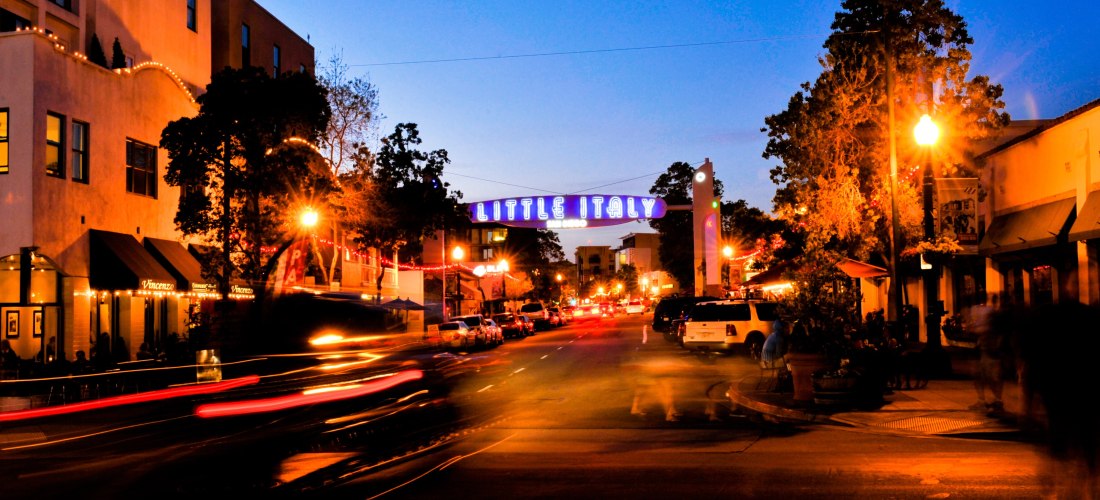
When I say, “density,” I picture a place like Little Italy. It’s a mix of townhouses, walk-up flats, small shops, churches, markets and restaurants. I can walk and bike around or drive my car when I want. I envision bumping into friends, enjoying our new Waterfront Park, drinking craft beer and eating from a variety of restaurants with a smile on my face.
But, when I say “density” to my mom, who lives in the a country ranch house and rides horses, she pictures downtown towers filled with people, an outright oppression of her outdoor lifestyle. And to my granny, “density” means the Huffman six-packs looming over her North Park neighborhood bungalow. These are the hastily built six-or-so apartment unit complexes on single-family lots throughout San Diego’s Mid-City. Granny’s still bitter.
You can measure the density of all of those things, because that’s all density is: a measurement of how many homes fi within an acre. That’s all. An that’s all it should be.
My mom’s ranchettes could be between one home per 20 acres or four homes per acre. My granny’s bungalow is between eight and 14 homes per acre, depending on whether she builds a secondary apartment or “granny flat” in her backyard. The townhouses and condos in Little Italy are between 20 and 60 acres per acre, and downtown’s towers are 80 or more homes per acre.
That’s how we use the “density” to measure different types of homes.
But “density” can’t do more than that. It doesn’t tell us what we need to know to make decisions about the places we want to live, and it misinforms the discussions we have about our future. Our city needs all of sorts of other restrictions, aside from density, to create different places, such as suburban Sabre Springs, more urban North Park, Little Italy or downtown. We have to add in restrictions for height, setbacks, parking ratios and how the property can be used. These many other requirements are what makes a zoning ordinance an unwiedly tome, perfect for bedtime reading.
San Diego is now open for business and dreams of being a corporate hub, but hosing for middle management is hard to find an build. And, focusing on density alone skews the market for building homes we know we need and the market will build.
Community groups will demand the city’s planning department will keep densities artificially low in the hope it will keep new housing away. These lower densities intended to stop growth actually push developers towards building just enough very expensive homes to make their profits. These larger, more expensive units aren’t appropriate for our older streetcar neighborhoods. This creates an unintended consequence: introduction of a different building type that conflicts with a community’s character, or skips a step in transitioning from less urban to more urban.
And, high density itself does not make for better development. Density doesn’t tell us anything about context, such as being in located in the center of a neighborhood, or its edge. Neighborhood-scaled, modest, well-designed density is almost impossible to achieve because of all of those other restrictions mentioned above being out of sync with its context.
Instead of addressing the issue head on – creating new codes and regulations that would allow the market to build a variety of housing types – we continue to rely on density measurements and conventional Land-Use Based zoning and hope for the best. So far that’s produced luxury towers, Huffman six-packs and large tracks of bland apartments in Kearny Mesa and Mira Mesa. The 50-year history of doing it this way has led to our collective mistrust in our neighborhoods between developers, locals, City Hall, and planning professionals.
Density and land use zoning were borne of conflicts with the industrial revolution and propagated old insurance companies’ discriminatory “redlining” practices against minorities in the 1930s. These companies outlined certain areas in red on maps and homes within these areas couldn’t buy insurance, and became the neighborhoods where marginalized minorities were allowed to live. Having insurance allowed homes to become larger and more expensive, which came to mean lower densities in those neighborhoods. While these discriminatory policies have stopped, our current zoning and density maps reflect and continue old redlining practices to this day.
We need better tools to discuss how we build anything new in San Diego.
I have long advocated for development regulations called “place-based codes” or “form-based codes” to replace the outdated zoning codes we use today. As seen in Denver and Miami, they’re better because they are built to understand that the type of place we want matters more than arbitrary measurements.
We should allow the market to set how much retail, residential or office spaces there is on a given street. We should protect our valuable historic neighborhoods. We should control how buildings transition from new to old. We should understand how to transition between different types of buildings to maintain and cultivate a community’s character. It is clear that our long-held conventional approach isn’t achieving these goals, and we have new development tools that can do these things.
But focussing a conversation on “density” can’t. Remember, it is just a number.
Howard Blackson leads an Urban Design Studio for International’s San Diego office.
Comments