Among sinuous hills dotted with olive groves, vineyards and cypress trees, winding country roads connect ancient medieval villages.
Around Siena you will discover a wonderful landscape that seems to stand the test of time.
So after seeing Siena, which Unesco defines as the absolute embodiment of the medieval city, set out to discover its province.
In the heart of Tuscany, between Chianti, Val d'Orcia, the Crete Senesi, Val di Chiana and Val d'Elsa, you will find yourself exploring quiet medieval villages, renowned wineries, ancient thermal baths immersed in the woods or in village squares, majestic abbeys shrouded in legend. Here are the best things to see around Siena.
San Gimignano
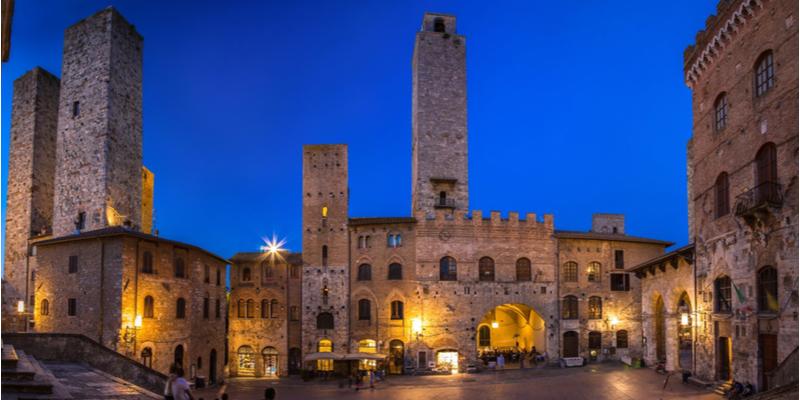
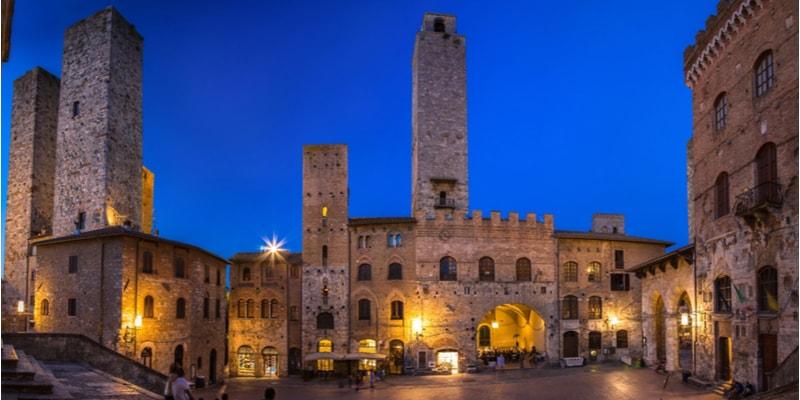
San Gimignano is often called the New York in the Middle Ages. Its skyline a few centuries ago was, in fact, designed by numerous towers. Apparently there were 72 and they soared austere towards the sky.
Today, only 13 remain, but San Gimignano remains a special village, inscribed on the UNESCO World Heritage List.
Situated in the Sienese hills of the Val d'Elsa, between the Chianti hills and the hills of the Val d'Orcia, San Gimignano arose in the late Middle Ages as a stopping place along the Via Francigena.
Wander around the historical centre until you reach Piazza della Cisterna, named after the large medieval cistern dating back to 1200. The square, whose charm has remained virtually intact over the centuries, is surrounded by tower houses and noble palaces, including Casa Salvestrini, Palazzo Tortoli and Palazzo dei Cortesi.
Then look for the Torre Grossa, the highest tower in San Gimignano, on which to climb to admire the beautiful panorama of the Val d'Elsa hills and the hills cultivated with Vernaccia. Those who want to learn about the history of this wine that is only produced within the boundaries of the San Gimignano territory should visit the Vernaccia Museum.
The Torture Museum, on the other hand, will take you back to the period of the Inquisition. Then browse the first floor of the museum centre of the Conservatorio di Santa Chiara di San Gimignano where the Spezieria di Santa Fina, the pharmacy of the old town hospital founded in 1253, has been reconstructed. Finally, do not miss the splendid frescoes of the Duomo and the Church of Sant'Agostino, or the masterpieces of the Museo Civico in the Palazzo Comunale.
Monteriggioni
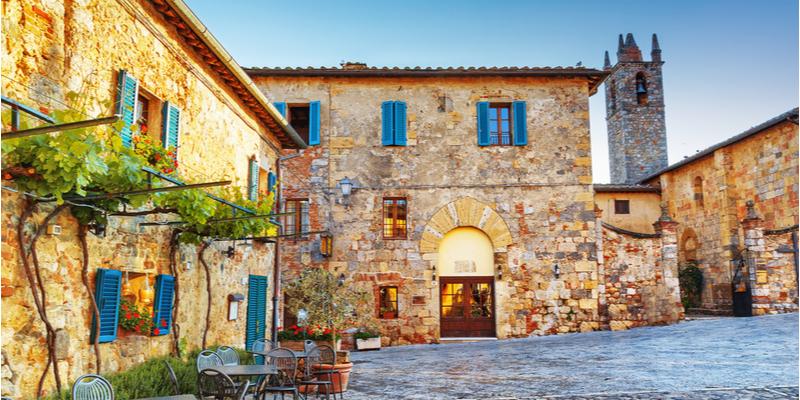
In the Val d'Orcia, only 20 km from Siena, on a gentle hill cultivated with olive trees and vines, there is a special village called Monteriggioni. The village is surrounded by perfectly intact circular medieval walls that recall the circular shape of the hill.
With its wide view of the surrounding hills and the Via Cassia, Monteriggioni was built as a fortification around the beginning of the 13th century to protect nearby Colle Val d'Elsa. The walls had 14 watchtowers and two gates to the fortress, one called Porta Romea or Franca, looking towards Rome, and the other Porta Fiorentina looking towards Florence.
The medieval walls you see today are the same ones that impressed Dante, so much so that he mentioned Monteriggioni in the XXXI canto of the Inferno, when he wrote "però che come sulla cerchia tonda Monteriggion di torri si corona" (however, that as on the round circle Monteriggion is crowned with towers), to indicate its majestic appearance similar to the towers of Nembrotto, Fialte and Anteo, the enormous giants embedded in the chasm of Malebolge.
And the 14 towers built to defend this territory for centuries disputed between Siena and Florence are still intact. At Monteriggioni, it seems as if time has stood still.
The best way to admire the whole village at a glance is to walk along the medieval walls that surround the town.
Piazza Roma, on the other hand, is the town's main square, overlooked by the Pieve di Santa Maria Assunta, a small Gothic-style church with two precious 15th-century tabernacles inside. Finally, Monteriggioni is a stop along the Via Francigena, making it ideal to reach on foot or by bicycle.
Colle Val d'Elsa
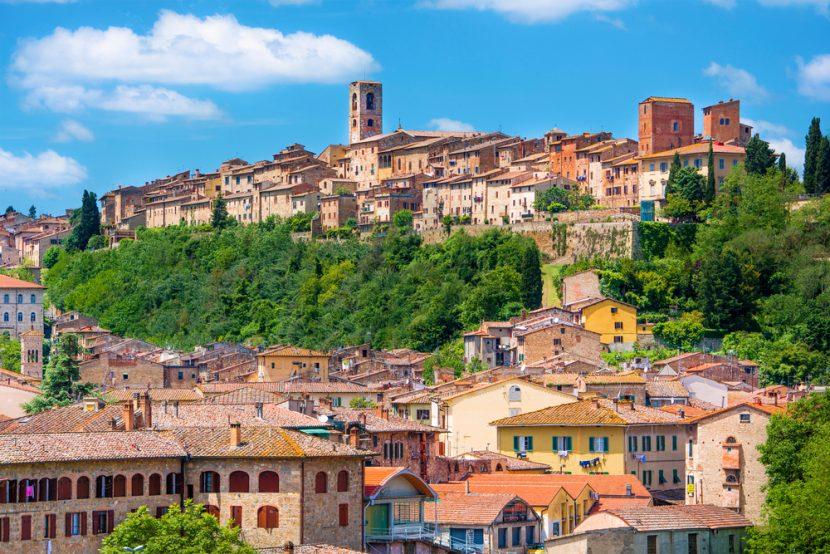
Less well-known than San Gimignano and Monteriggioni, but just as fascinating. Colle Val d'Elsa is known as the 'city of crystal' because of its centuries-old craft tradition. Today, 95% of the crystal produced in Italy and 14% of the world's crystal comes from here.
If you want to learn more, visit the Crystal Museum in the lower part of the modern city. Then take the public lift up to the historic centre, high up on the hill.
You will find yourself on a terrace with a wonderful view of the lower part of the city, the Tuscan hills and the surrounding countryside.
Soak up the medieval atmosphere of the historic centre and visit the beautiful Duomo. The 16th-century Palazzo del Capitano, Palazzo Buonaccorsi (15th century), Palazzo Giusti (15th-16th century), and the tower-house where the famous architect Arnolfo di Cambio was born (13th century) are also in the old heart of the town.
Between one crystal showcase and the next, admire the village and the castle, which can be accessed from the Ponte del Campana, one of the most evocative corners of Colle Val D'Elsa.
Pienza
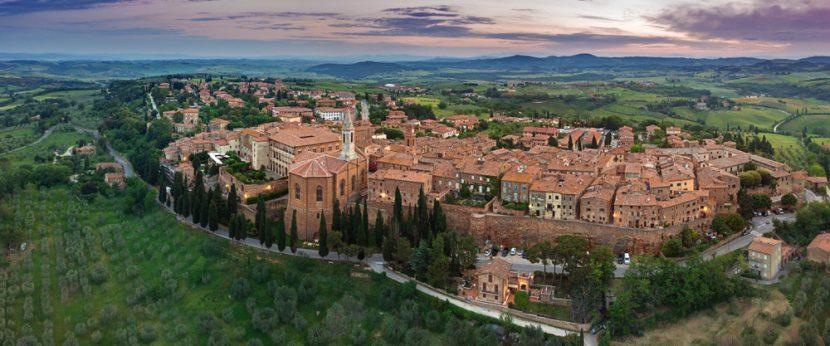
Pienza is a small village south of Siena, situated on a hilltop overlooking the entire Val d'Orcia. Pienza is known as the 'ideal' city of the Renaissance, created by the humanist Enea Silvio Piccolomini, who later became Pope Pius II.
Piccolomini had the economic possibilities and influence to transform his native village, Corsignano, into what he believed should be a utopian city, according to the principles of the great Italian Renaissance.
The project was then entrusted to the architect Bernardo known as Rossellino, under the guidance of the great humanist Leon Battista Alberti.
In just three years, a complex of beautiful and harmonious palaces was built, which still make up the centre of the town: the cathedral, the papal residence or Palazzo Piccolomini, the Town Hall, and the enchanting central square, Piazza Pio II, with its distinctive trapezoidal shape and herringbone paving.
After admiring Palazzo Piccolomini and the Town Hall, visit the Duomo or Cathedral of the Assumption, which houses important paintings by the most renowned artists of the time. Then stroll through the shops of Corso Rossellino.
The Chianti hills: Greve and Montefioralle
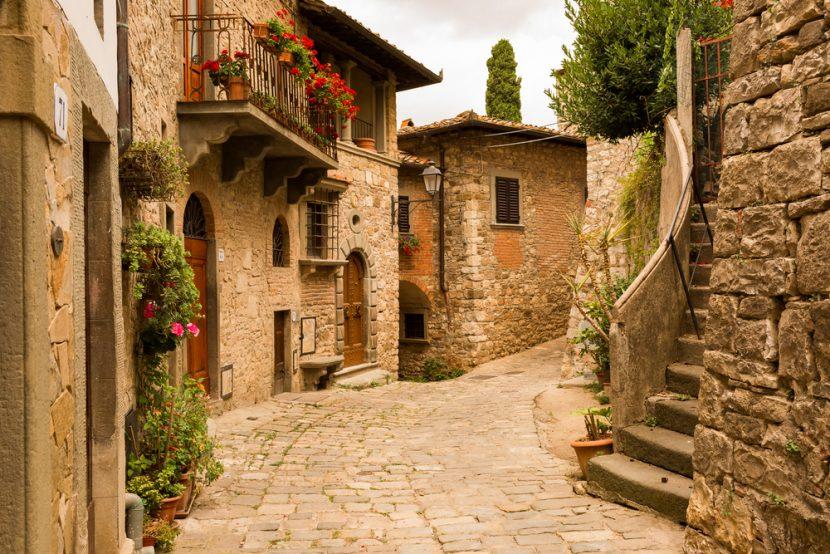
In the hilly area between Florence and Siena, you will find yourself in a fabulous landscape of dense chestnut, oak and holm-oak woods, picturesque medieval villages, romantic castles, beautiful farmhouses, but above all huge expanses of vineyards.
This is the heart of Tuscany where a world-famous red wine, Chianti, is produced.
Stop in the medieval village of Greve to taste this ancient wine before continuing on to Montefioralle, a charming fortified village dominated by its ancient castle.
Montepulciano
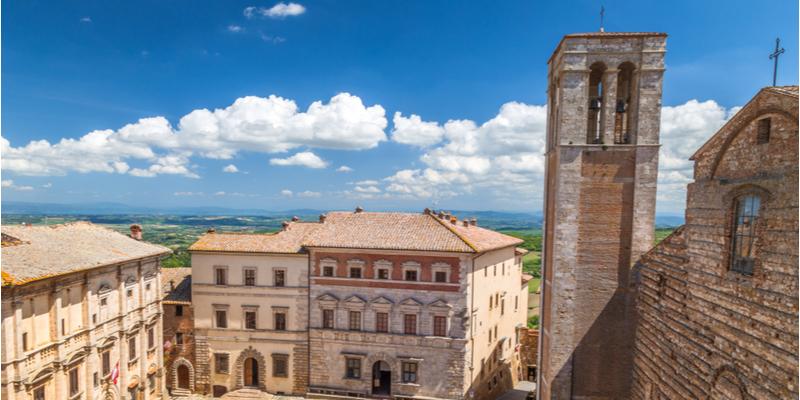
Perched on top of a hill between the Val di Chiana and Val d'Orcia, Montepulciano has historically represented a sort of Florentine enclave in Sienese territory.
It is a charming medieval town whose origins date back to Etruscan times, where one can stroll among Renaissance palaces, ancient churches, enchanting squares and panoramic views of the vineyard-covered Tuscan hills.
Montepulciano is remembered for being the birthplace of the great Renaissance poet Agnolo Ambrogini, better known as Il Poliziano.
But it is also famous for its Nobile wine, one of the finest Italian reds with a controlled and guaranteed designation of origin.
Surrounded by ancient walls, Montepulciano contains, among the narrow streets and small squares of the historic centre, marvellous palaces and sumptuous residences, evidence of the great power that noble families had during the 14th and 15th centuries.
The Duomo will impress you with its unfinished wall façade, never completed, but harmonious inside, which houses masterpieces such as the triptych by Taddeo di Bartolo and the painting of the Madonna del Pilastro by Sano di Pietro. The church of Sant'Agostino, on the other hand, stands out for its precious Renaissance-style façade, but the church and convent of San Francesco is one of the oldest religious buildings in Montepulciano.
In Palazzo Neri-Orselli in Via Ricci, a splendid 14th-century building, you will then find the Museo Civico and the Crociani Art Gallery. Finally, do not miss the fortress, a symbolic place of Montepulciano.
The splendid architectural construction, located a few steps from Piazza Grande, towers over the town, and offers a wonderful view of the Val di Chiana and Val d'Orcia. Finally, treat yourself to a few pleasures such as a visit to the wine cellars or a bath in the thermal baths of Montepulciano.
Abbey of San Galgano
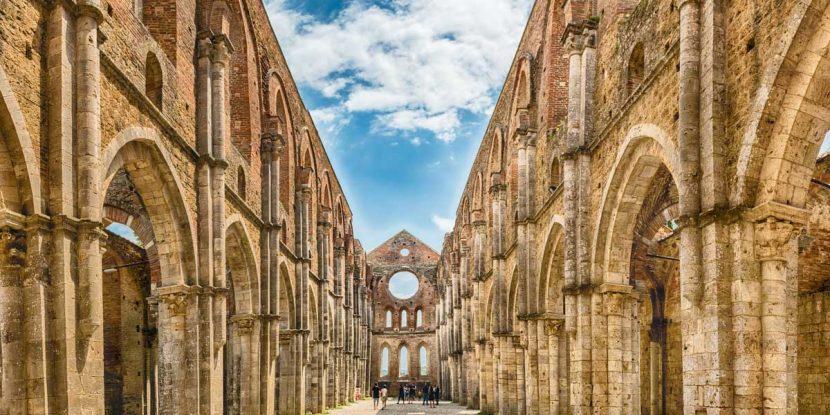
The legendary sword in the stone, usually associated with the legend of King Arthur, exists and is located in Tuscany, precisely in San Galgano, 24 km from Siena.
Imagine a basilica with a Latin cross plan and three naves, 72 metres long and 21 metres wide, with the outer walls still intact, but without a roof. Built in 1218, the Cistercian abbey experienced moments of great splendour until it was abandoned. So today you will see it as a majestic ruin without a ceiling.
But before the abbey, the Hermitage of Montesiepi was built, between 1182 and 1185, on the hill where, according to legend, St Galgano lived as a hermit in the last year of his life. Inside the Hermitage of Montesiepi is kept a sword, stuck up to the hilt inside a stone.
The sword in the rock belonged to Galgano Guidotti, a brave and dissolute knight, born in 1148 near Chiusdino, who was seized by a religious conversion and decided to retire as a hermit near his home town. Once there, he drove his sword into the rock as a sign of renouncing violence and to create a cross on which to pray.
The many similarities between Saint Galgano and Galvanus, one of King Arthur's knights, have made many people fantasize. What is certain is that over the years hundreds of people have tried to extract and steal the sword. In the hermitage it is possible to see what are believed to be the mummified hands of a thief who, in an attempt to extract the weapon in vain, was mauled by wild wolves.
The sword in the rock was considered a fake for years although recent studies have shown that the material, as well as the style and forging, can date back to a period from the 1100s to the early 1200s. In any case, the Abbey of San Galgano remains a mystical place.
Bagno Vignoni
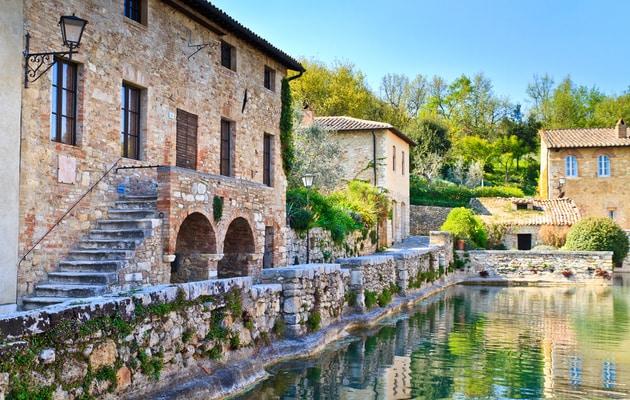
Bagno Vignoni has one of the most beautiful squares in Italy. It is unusual to see a square occupied by a large medieval pool where thermal water gushes out at 52 C°.
About 50 km from Siena lies this special village immersed in a fairytale atmosphere. The Piazza delle Sorgenti is overlooked by Renaissance buildings and elegant loggias, which in the evening are obscured by the steam from the thermal water.
During the Renaissance, the scions of noble Tuscan families frequented the loggias and palaces in front of the pool at Bagno Vignoni, which was a popular holiday destination.
The thermal water that gushes out in Piazza delle Sorgenti then heads to the Parco dei Mulini, where an incredible work of hydraulic engineering from the Middle Ages was built. The Parco dei Mulini can be visited all year round and is marked by paths leading to four mills, some dug into the rock and others partly underground.
Bagni di San Filippo
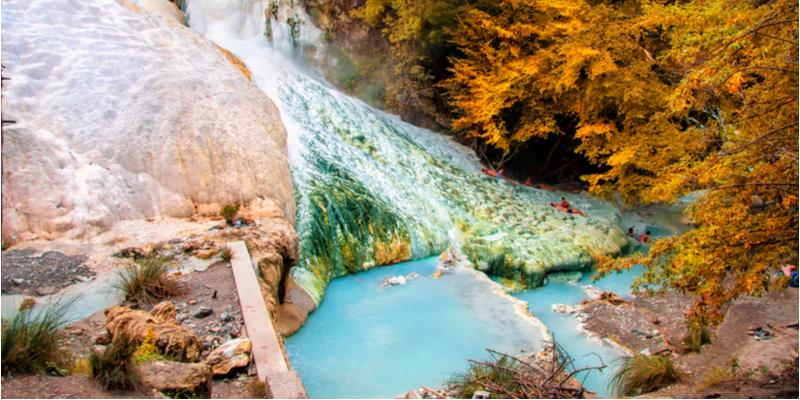
Slightly further from Bagno Vignoni, about 70 km from Siena, in the heart of the Val d'Orcia lies the small village of Bagni di San Filippo.
Here, in addition to a paid spa, there are free spas, hidden in the green woods at the foot of Monte Amiata.
These free spas can be reached by crossing a small path through the woods that leads to the Fosso Bianco, the stream where the hot water springs converge. Over time, they have created an enchanting scenery of white limestone mountains from which boiling water gushes out into small natural pools.
At this point, the hot water of the thermal springs meets the cold water of the river, giving it a blue-white colour that creates a beautiful contrast with the green of the surrounding vegetation.
San Casciano dei Bagni
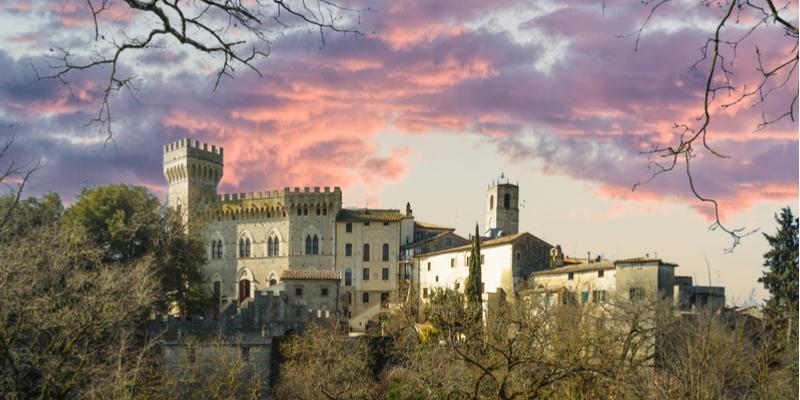
In the Sienese Val di Chiana there is another enchanting village with other suggestive free spas. San Casciano dei Bagni, about 90 km from Siena, is a small medieval village but also one of the most beautiful and elegant spas in Italy.
There are 42 thermal springs, from which the Etruscans and Romans already benefited. There are two free baths, which were once wash-houses, immersed in nature: Bagno Grande, a natural hydro-massage thanks to the gaseous bubbles coming from the thermal surface, and Bagno Bossolo, a smaller pool but with higher temperatures.
The historic centre is also worth a visit to relax in the tranquillity of its narrow streets, but also to admire the remains of the city walls and the Collegiate Church of San Leonardo.
Montalcino
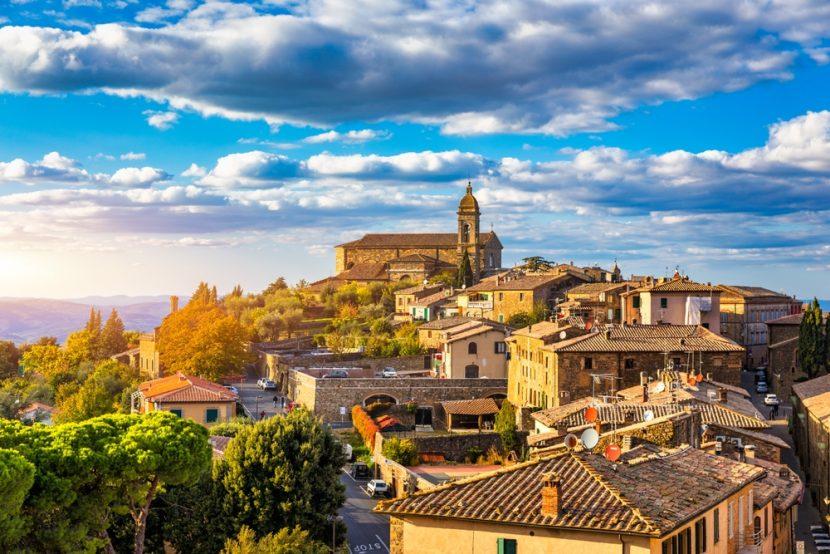
Leaving Siena, you will find yourself in the hills with enchanting villages and immense vineyards.
Stop in Montalcino, the town that is the birthplace of Brunello, one of Tuscany's most famous wines, to discover its cellars but also its medieval centre protected by ancient walls. The village has remained virtually intact since the 16th century.
The historic centre is dominated by the mighty Rocca, a fortress built in 1361 to mark the town's passage under the rule of Siena. From the bastions of the fortress, you will enjoy a spectacular panorama that stretches from Monte Amiata to the hills of the Maremma.
Then visit the Bishop's Palace and the churches of Sant'Agostino, Sant'Egidio and San Francesco. Finally, reach the summit on which Montalcino stands to see the spectacle of a continuous succession of sinuous hills dotted with olive trees, cypresses and vineyards.
San Quirico
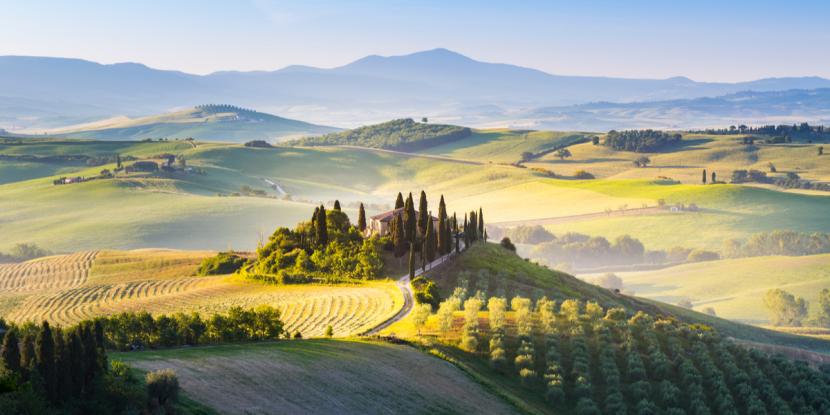
A few kilometres from Montalcino is San Quirico, an excellent food and wine stop with equally breathtaking views over the Val d'Orcia, but also a cultural stop where art lovers can visit the Collegiata dei Santi Quirico e Giuditta.
It is a splendid Romanesque church with Gothic and Baroque elements, characterised by three beautiful entrances with sculptures of lions, all different from each other.
Next to the Collegiate Church is Palazzo Chigi, a beautiful palace that today houses the city municipality. It is also worth visiting the Church of San Francesco, also known as the Church of the Madonna, as it houses the terracotta statue of the Madonna by Andrea della Robbia. An important stop along the Via Francigena in the Middle Ages, San Quirico retains its original charm.
Chianti Sculpture Park
Among the villages and hills in the province of Siena, there is an open-air museum where nature welcomes contemporary works of art.
The Chianti Sculpture Park is located in Pievasciata, in the heart of the Chianti region of Siena. The project was initiated by the Giadrossi couple who inaugurated the space in May 2004.
Along a one-kilometre route, works by 27 artists from all over the world are exhibited. Each individual sculpture was proposed by the artist after visiting the forest and choosing its place. Some sculptures are interactive, such as the Labyrinth by British artist Jeff Saward with its 80-metre-long path.
In summer, the park hosts numerous concerts in the amphitheatre. Don't leave without taking a trip to the small village a stone's throw from the park, Pievasciata, which is being transformed into the Borgo d'Arte Contemporanea.
Italy
Tuscany
Siena