Best Things to Do:
Those who stroll through Prague might be puzzled at certain spots. Is there really a rear on two legs for people to look into? Why is there a figure of a man hanging over the street? And what's odd about this equestrian statue?
Humor Meets Controversy: This is David Černý
Prague owes its many quirky artworks to the Czech artist David Černý. The 56-year-old was born in Prague and studied art there. He became known for painting a Soviet tank pink in 1991. However, it wasn't just any tank; it was a monument to Soviet tank crews, which was a national cultural landmark at the time. Černý was briefly detained for vandalism. Today, the tank is located at the entrance of the Military Technical Museum Lešany in Prague.
The tank was just the beginning of a sculpture journey that David Černý continues to decorate the city with to this day. Recently, he even opened his own museum. However, it is not simply titled a museum, but a Musoleum - a mix of mausoleum and museum.
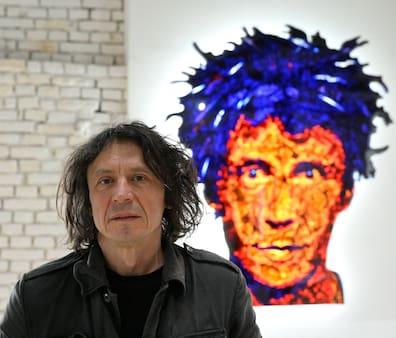
Černý himself explains the unusual name on the Musoleum's homepage as follows: 'The decision also resulted from my inability to agree with the National Gallery, which wanted a solo exhibition of mine.' It's therefore a mausoleum for the dead idea with the National Gallery. Moreover, the Musoleum moved into a building that has been a ruin for over 20 years, as further stated.
What to Expect at the Musoleum in Prague
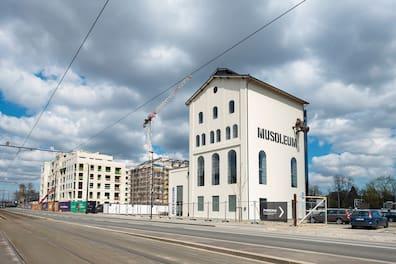
The Musoleum is located in a historic brewery building that is part of the old Smíchov distillery. From the ruins, David Černý together with his architectural firm Black n' Arch and the Trigema Group created a five-story gallery. Alongside the gallery, there are also apartments, and a gastronomic and cultural center.
In the new Musoleum, visitors can now discover many of Černý's works in the permanent exhibition. Among them is the Trabant on four legs. The exhibition includes artworks and installations that have never been publicly seen before.
All the information about the Musoleum in Prague: The Musoleum is open Monday to Friday from 1 PM to 7 PM, and on Saturdays and Sundays from 10 AM to 6 PM. Tickets for the permanent exhibition cost 300 Czech crowns (CZK), which is about 12 euros. The address is: Nádražní 2, Prague 15000.
Where to Find David Černý's Art in Prague
But not only in the new Musoleum you can discover the art of David Černý, it also pops up all around Prague. Where exactly, we will reveal to you now.
The Upside-Down Horse
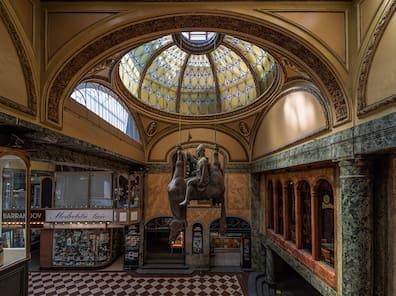
If you are near Wenceslas Square, you should visit the Lucerna Passage. The passage itself is a modernist building with Art Nouveau elements, but the absolute eye-catcher is David Černý's interpretation of the famous Wenceslas equestrian statue.
Here, the horse hangs from the ceiling and Wenceslas sits on the belly of the animal. The artist wanted to create an ironic adaption of the equestrian statue from Wenceslas Square and today it is a true tourist attraction.
Kafka's Twisted Head
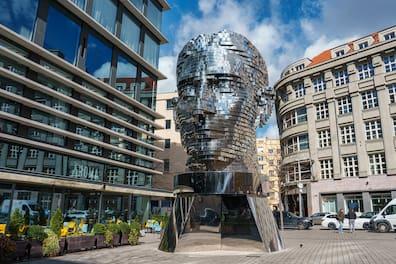
David Černý has also immortalized the famous writer Franz Kafka in an unmistakable sculpture near the Quadrio shopping center. The shiny silver head of Kafka weighs almost 40 tons and consists of 42 movable levels that all rotate independently.
The sculpture has been at the site since 2014 and is seen as a reference to the work 'The Metamorphosis'. As is often the case in art, the statue of Kafka does not please everyone. While many see it as a link between art and modern technology, some view it as a glittering attraction lacking a real connection to Kafka.
The Hanging Man
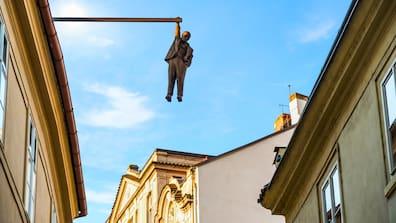
If you're in Prague's Old Town on Husova Street, look up. You'll discover a man seemingly holding onto a pole with only one hand. But don't worry, the man isn't real; the spectacle is another highlight by David Černý.
However, it's not just any man, but Sigmund Freud. Why Černý depicts the famous psychoanalyst ending his life in this particular street remains the artist's secret. One theory is that the thin line between genius and madness can be as narrow as the one between life and death, speculates 'Radio Prague International'.
Back in the Womb
Another bizarre figure reminiscent of Kafka's head stands in front of the Gallery Golf Hostivař. The artwork depicts a six-meter-tall pregnant woman holding her head. The piece is made of stainless steel and includes a feature you must want to try: you can crawl into the womb.
The figure 'In Utero' was installed in 2013 in the small square between Dlouhá Street and Masná Street but had to be removed from there upon the monument protection authority's order.
(Too) Deep Insights
And if you can crawl into a womb, why not also take a peek into a rear? No problem, David Černý has something for this interest too, namely 'Brown Nosing'. The sculpture stands in the courtyard of the Futura Gallery, which unfortunately is temporarily closed.
Two bodies bent forward with their backs exposed disappear into the house wall. More prominent is the rear end, to whose opening a ladder leads. If you stick your head into the opening, a video is shown in which former President Václav Klaus and the former director of the National Gallery in Prague feed each other oatmeal.
Faceless Babies
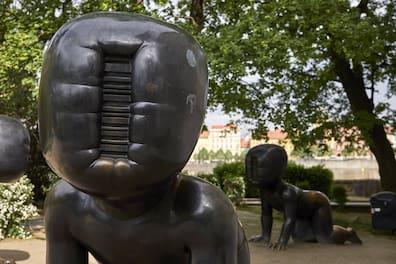
They are among David Černý's most famous works and have stood in other places, such as Dresden's Terrassenufers. We're talking about the faceless crawling baby sculptures, also called Miminka. They are made of bronze, and each figure weighs about 800 kilograms.
The crawling babies have a recessed hole with a barcode instead of a face. They likely reference the communist era when babies couldn't reach adulthood, crawling around mindlessly and without understanding. They crawl along the pillars of the Prague TV Tower and stand in the park at the entrance to the Kampa Museum (Ostrov Kampa, 118 00 Malá Strana).
Manneken Pis Grow Up
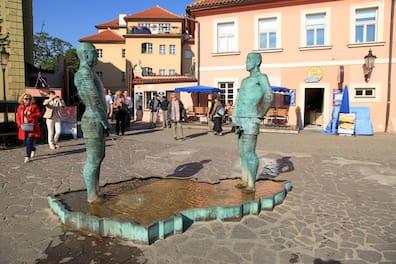
A small, urinating figure gained great fame in the Belgian capital Brussels, with tourists gathering daily around the tiny statue. In Prague, one might think, you find the next kin of this little figure, only here, two figures urinate, and they are already adults.
The so-called Piss Fountain features two urinating men and is located near the famous Charles Bridge at the Franz Kafka Museum. The two figures urinate into a pond shaped like the Czech Republic. In 2024, David Černý told the 'Los Angeles Times' that it represents a portrayal 'typical of Czech dialogue, where one tries to outsmart or advance to the detriment of the other'.
Looking for more inspiration? Find tips for all top travel destinations at bettercities.net.
bettercities.net