The 10 Most Beautiful Attractions in Namur
Namur is located at the confluence of the Sambre and Meuse rivers in Wallonia, about 40 miles southeast of Belgium's capital, Brussels. Wallonia, alongside Flanders and the capital Brussels, is one of the three regions in Belgium. Approximately 115,000 residents live in the city, which is a so-called 'Transition Town'. This means Namur focuses on intelligent and sustainable city development. Here are the attractions you must not miss during your visit to Namur.
1. Citadel of Namur
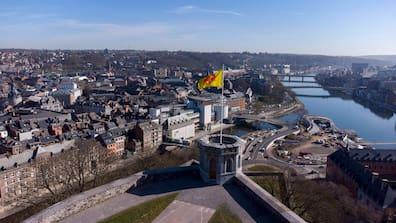
Namur's top attraction even caught Napoleon's attention. He referred to the Citadel as the 'Termite Hill of Europe'. The Citadel sits atop a rock overlooking the old town, 656 feet above Namur. Spanning about 200 acres of fortifications, castle, and pathways, it is one of the largest fortress complexes in all of Europe.
The modern visitor center is located in the former fort 'Terra Nova'. It covers 2,000 years of European urban and military history. Guided tours are available, exploring the underground facilities: 1,476 feet have been restored and equipped with light-sound installations and 3-D animations. Excitingly, the underground passages host the perfumery 'Guy Delforge'. Here, fragrances are created in the Citadel, and you can learn everything about the stages of making a perfume.
2. Cable Car of Namur
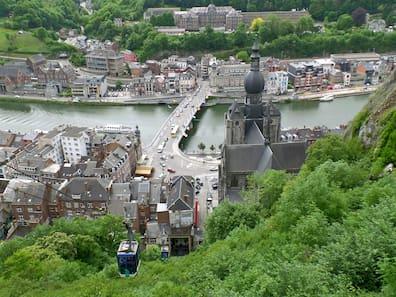
If you don't wish to walk up to the Citadel, take the shuttle bus or the cable car. Until the 1990s, a cable car once ascended the mountain, then stopped operations. In 2021, the new 'Téléphérique de la Citadelle de Namur' opened, becoming a new attraction. The view over the city from above is spectacular.
The cable car spans the Sambre river from Place Maurice Servais in the historic city center, crosses over the fortress walls of the Citadel, and gently lands 2,133 feet away on the Esplanade, overcoming a height difference of 338 feet - in just a four-minute ride.
3. Place d'Armes
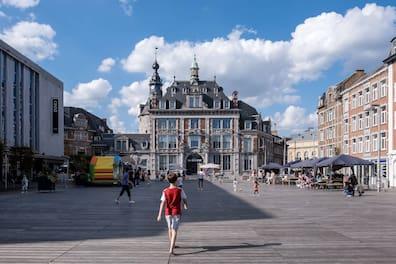
Another landmark of the city is the market square at the heart of Namur. Previously known as Grand Place, public executions took place here until World War I, and the town hall dominated the area. The town hall was destroyed during World War I and later rebuilt on Rue de Fer.
Today, the square is known as Place d'Armes (Parade Square) and is surrounded by cafes, restaurants, and important buildings such as the former commodities exchange, now the Palais des Congrès, or the congress center where official receptions and conferences are held. Notable is the monument of bronze figures Djoseph èt Françwès (English: Joe and Frank). They are the Belgian version of Laurel and Hardy. They pose with leashed snails - a loving nod to the local culture and the laid-back nature of Namur's residents.
4. Place du Marché aux Légumes
The bustling heart of Namur lies at Place du Marché aux Légumes, where countless bars and restaurants line up. One of these holds a proud record: The 'Ratin-Tout' is the oldest café in Namur, serving guests since its opening in 1616.
There's always something happening at the Place du Marché aux Légumes. In the evenings, aperitifs are served, and of course, there's beer. For something special, try a Trappist beer. The designation 'Bière Trappiste' has strict criteria. Beer is brewed under the supervision of Trappist monks in the monastery, and the proceeds go to social projects. There are only ten Trappist breweries, five of which are in Belgium.
5. Saint-Loup Church
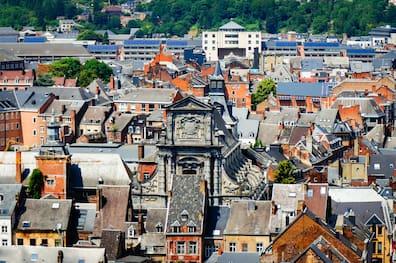
Directly in the old town stands Saint-Loup Church, known as one of the most beautiful Baroque buildings in all of Belgium. Designed by Brother Huyssens, the church was built between 1621 and 1645. His goal was to employ a local architectural style to make the church accessible to the public.
Brother Huyssens used interior decor of red and black marble and a sandstone vault with high reliefs, avoiding excessive opulence. The main altar is also made of marble, and the confessionals and neobaroque pulpit are crafted from oak.
6. Musée Félicien Rops
A museum dedicated to a famous resident of the city: Félicien Rops was a Belgian artist, graphic designer, and illustrator of Symbolism. In 1868, he co-founded the 'Société des Beaux Arts' in Brussels and was a pioneer of Belgian Realism.
At the Musée Félicien Rops, housed in a former manor in the old town, everything revolves around Rops' work - from his beginnings marked by social satire and caricatures to his typical themes of women, erotica, death, literature, and travel, with which he combated the moral rigidity of the bourgeoisie.
7. Belfry of Namur
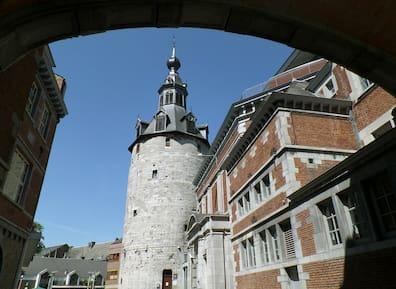
The Belfry of Namur (Tour Saint-Jacques) tells a story steeped in history. A belfry is a tall, slender bell tower, typical of Flemish cities. Standing over 65 feet tall, the Belfry of Namur is a remarkable example of 14th-century military architecture.
Construction of the round tower made of limestone, originally known as the 'Saint-Jacques Tower', began in 1388. At that time, it was part of the city wall. It wasn't until 1746, after the siege of Namur and the church's destruction, that it was transformed into a bell tower. The Belfry was declared a World Heritage Site by UNESCO in 1999.
8. Cathedral St. Aubain
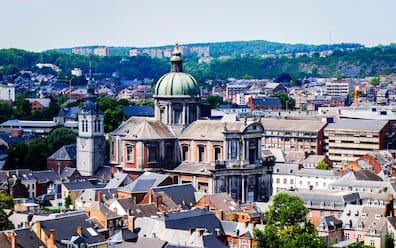
A touch of Italy sweeps through Namur as you stand in front of the Baroque Cathedral of Saint Aubain. No wonder: The Italian architect Gaetino Pizzoni designed the rust-red church, modeling it after St. Peter's Basilica in Rome. The exceptional structure was built from 1751 to 1767 and is a mix of neoclassical and Baroque architectural styles.
Unlike traditional Christian churches oriented from east to west, the Cathedral St. Aubin is oriented from west to east, forming a Latin cross on the ground. The rounded facade is adorned with 20 Corinthian columns and five statues. The interior is equally impressive, with a total length of 256 feet and a height of 79 feet in the nave, transept, and choir. The cathedral houses several artworks, including paintings by Anton van Dyck, Jacob Jordaens, and Jacques Nicolaï.
9. Musée des Arts anciens
In a heritage-protected patrician house from the 18th century, local art is the focus in the old city. The 'TreM.a', or the Museum of Ancient Arts, has been showcasing works from the region since 1964, especially goldsmith's work from the Middle Ages and art from the Renaissance.
Particularly noteworthy is the world's largest collection of works by Henri Blès, a famous Flemish landscape painter of the Renaissance, the coin cabinet, the print cabinet, and many sculptures and landscape paintings. The museum also houses the Trésor d'Oignies, one of Belgium's seven wonders.
10. Le NID
At the confluence of the Sambre and Meuse, Namur reveals its modern face. Here stands the striking glass building of Le NID (Namur Intelligente et Durable), accessible via a circular path. From here, one has a great view of the pedestrian bridge L'Enjambée and the Citadel.
Inside is an exhibition focused on Namur's city development, covering the city's beginnings, current transformation, and future. It features three rooms with short videos, video mapping, interactive tables, virtual reality, and 3-D elements. Emphasis is placed on sustainable development, for example, through city greening, smarter traffic management, and more places for citizens to interact.
Looking for more inspiration? Find tips for all top travel destinations at bettercities.net,