Best Things to Do:
- 1. Monaco-Ville
- 2. Fontvieille
- 3. La Condamine
- 4. Les Moneghetti
- 5. Larvotto
The Principality of Monaco is the second smallest state in the world after Vatican City and also one of the most densely populated: It attracts the wealthy and celebrities to this tax haven on the Mediterranean. 39,100 residents are spread over just over two square kilometers - and across nine districts. Many are worth a visit and can compete well with the tourist hotspot of Monte Carlo. A selection.
Monaco-Ville
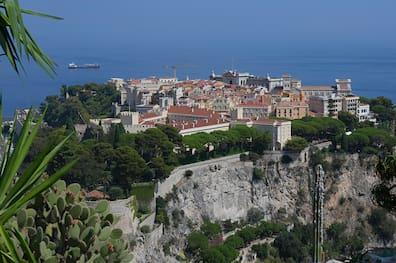
After Monte Carlo, Monaco-Ville is probably the most visited district. The locals also call it Le Rocher, meaning the Rock. Rightly so: The oldest and smallest Monegasque district is located on a rocky peninsula and rises 60 meters above the Mediterranean Sea.
The Palace of the Grimaldis is here, as is the main church of Monaco, the Cathedral of Our Lady Immaculate. Visitors can stroll through medieval alleys and watch the changing of the guard of the Carabinier Guards at the Justice and Prince's Palace daily at 11:55 AM.
Also located in Monaco-Ville is the Oceanographic Institute, founded in 1910, which was led for many years by Jacques Cousteau. The associated museum features one of the largest coral reefs on earth. In an underwater world with 400 cubic meters of water, visitors can admire hammerhead sharks, rays, colorful tropical fish, and countless live corals.
Fontvieille
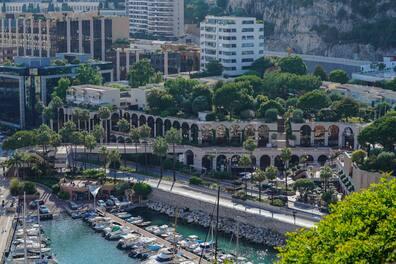
Fontvieille borders Monaco-Ville to the northeast - and the visual contrast could hardly be greater. Unlike the medieval old town, Fontvieille is considered a high-tech district. Many environmentally friendly technology companies have been allowed to settle in the district, which was established by the late Prince Rainier III from the 1960s onward. The land on which the high-rise buildings, a stadium, a university, and a second marina were built was reclaimed from the Mediterranean over 15 years; the area is artificially created.
Fontvieille also has a second face: Art and cultural institutions are housed here, such as a sculpture path with works by sculptors like Arman, Fernando Botero, and César, Rainier's car collection with 100 exclusive vehicles, and the Rose Garden dedicated to his late wife Gracia Patricia, with nearly 180 varieties of roses and 4000 bushes.
Visitors wishing to see the principality from above should head to Fontvieille: Two companies offer helicopter tours.
La Condamine
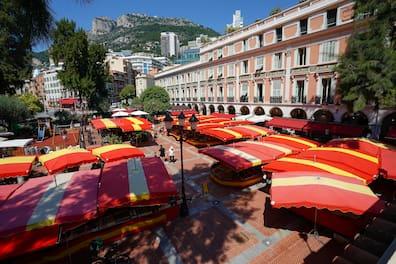
La Condamine is probably particularly well-known to motorsport fans; the start and finish area, and large sections of the annual Formula 1 street race, are located in this district. For most of the year, however, La Condamine shows a completely different picture: The Monegasques call the district the heart of Monaco.
Gourmets can stock up on regional foods daily at the open-air market on Place d'Armes. In the gourmet market hall, which opened in 1880, there are international and Monegasque specialties such as Socca, a chickpea flour crepe, Barbajuan pastries filled with spinach, ricotta, or chard, and Pissaladière onion tart with anchovies and olives, available from Tuesday to Saturday evenings.
Many locals meet for an aperitif in one of the eateries in the arcade corridors on the square. On the Promenade des Hercule Harbor, walkers can admire luxury yachts and in the evening meet other night owls in bars and restaurants.
Les Moneghetti
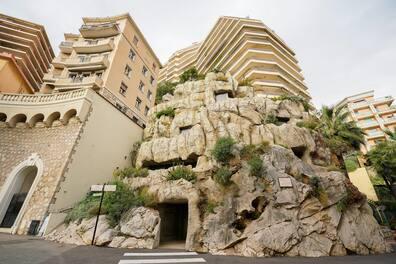
The district of Les Moneghetti is located on the far west of Monaco and borders the French commune of Beausoleil. Architecture fans will find plenty to admire in Les Moneghetti - buildings from various architectural styles and eras stand here, including the Persian-style Villa Isfahan, the snow-white futuristic high-rise La Simona on Boulevard du Jardin Exotique, and the ultra-modern private Villa Troglodyte, which architects built into a rock on Avenue Hector Otto without destroying it or its vegetation.
Another highlight is the Jardin Exotique de Monaco, the Exotic Garden: it was created on a slope in 1933. Numerous succulents from the USA, Central and South America, Africa, and the Arabian Peninsula thrive there. Thanks to its elevated location, visitors enjoy a wide view over the principality. Part of the garden is a cave with stalagmites and stalactites, as well as limestone columns and drapes. Cave visitors climb over 300 stairs from 40 to 98 meters in height.
Larvotto
Those who want to go to the beach in the principality should head to the Larvotto district at the eastern edge of Monaco. The Larvotto Beach extends along Avenue Princesse Grace for a length of 400 meters and consists of two coves. For water sports fans, there are snorkeling and diving offers, as well as jet skiing, kite- and windsurfing. The beach has a section called Handiplage that is accessible to people with disabilities. An audio system installed on land and in the water helps the visually impaired and blind with orientation. On the beach promenade, bathers find cozy beach restaurants.
500 meters south of Larvotto Beach is the Champions Promenade: footprints engraved in concrete honor soccer players like Michel Platini or Diego Maradona. Those heading there will pass the honeycomb-shaped Grimaldi Forum, a congress and cultural center where the Monte-Carlo Ballet and the Monaco Philharmonic Orchestra regularly perform.
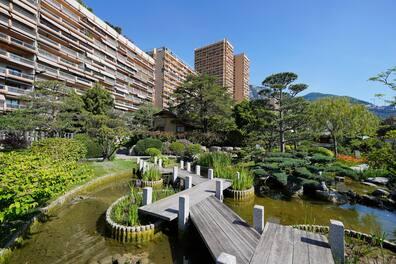
Right next to the Champions Promenade lies the 7000 square meter Jardin Japonais de Monaco; the landscape architect Yasuo Beppu designed the Japanese garden right on the Mediterranean coast.