City Trip to the Past
Just 28 miles north of Denmark's capital Copenhagen lies Helsingør, a town with about 48,000 residents. Many travelers head there only for the crossing to Sweden-Helsingør is located at the narrowest part of the Øresund, just 2.2 miles from Helsingborg in Sweden, a 20-minute ferry ride away.
However, it's worth dedicating at least a few days to this town. The highlights it offers range from Denmark's Maritime Museum to culinary delights, but Helsingør is particularly known for two things: its old town, which is one of the best-preserved in Europe, and 'Hamlet's Castle,' as Kronborg Castle inspired Shakespeare to one of his most famous works. We'll show you all the things you can experience in and around Helsingør's old town.
The Highlights of Helsingør's Old Town
From Fishing Village to Trade Metropolis
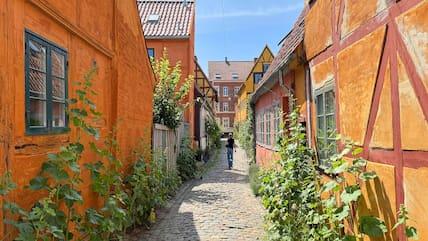
Strolling through Helsingør's old town feels like a time travel experience-one where everything is still alive, fragrant, and full of stories. In the cobblestone streets, where flowers adorn colorful, partly centuries-old half-timbered houses, you can feel it: the charm of the idyllic fishing village Helsingør once was. Some houses lean, others have crooked gables, many have been lovingly restored.
What's special is that today's old town layout still dates back to King Eric of Pomerania (also Eric VII, 1382-1459). He arranged three longitudinal streets parallel to the coast and four cross alleys at right angles-a grid pattern you can still recognize during a stroll through the old town today.
Travelers not only encounter King Eric VII in the town's design. He is omnipresent, as he made Helsingør the center of the Danish kingdom in the 15th century: in 1426, he introduced the 'Sound Toll,' requiring every ship passing through the Øresund to hand over a gold coin. This money flowed directly into the royal coffers for 400 more years. Under Eric VII, Helsingør became an international trading hub and will celebrate its 600th anniversary in 2026.
Old Town Walk in Helsingør with Many Surprises
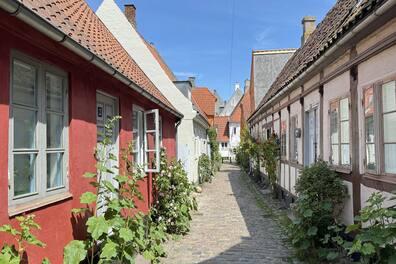
As one of Helsingør's oldest streets, existing since the 17th century, Anna Queens Stræde is especially notable. During the time of the Sound Toll, this cobblestone street with its colorful half-timbered houses was a favorite gathering spot for ferrymen. However, the oldest preserved half-timbered house in Helsingør stands a few streets away at Strandgade 27. It dates from 1577. The upper floor juts out over the ground floor and is supported by intricately carved wooden brackets.
During a stroll through the old town of Helsingør, you'll encounter surprises time and again: here, the peaceful cloisters of St. Mary's Church; there, the green courtyard of the restaurant Patios, which offers delicious vegetarian dishes in addition to coffee and cake. If you see a long line in a street outside a shop, you've found a culinary highlight of the old town: the popular little ice cream shop Brustræde Fløde Is, operating since 1922.
While exploring the area, the travel bettercities.net also discovered a unique experience: a city tour with Hannah Kirkland from Helsingør Guide Tours. To meet her, you descend into a hidden Renaissance cellar under the Szengade 77, the main street of the old town. Suddenly you find yourself in a room like something out of another time-with cool air, white busts, long wooden benches and tables, topped with coffee and cake illuminated by candlelight. As you indulge, Hannah shares the city's history, accompanied by Renaissance music as once played at the Danish court.
The cellar dates back to the same period as Kronborg Castle, the late Renaissance, and served as a hospital kitchen for many years. Afterwards, Hannah guides you through the hidden corners of the old town, including a tombstone monument of 'King Hamlet.' But to really learn what Shakespeare has to do with Helsingør, you must visit Kronborg Castle on the peninsula opposite the old town.
Kronborg Castle in Helsingør
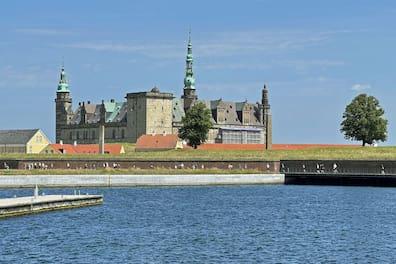
Where the Øresund is narrowest, just 2.2 miles from Sweden, Kronborg Castle towers over the Baltic Sea. Originally constructed as a fortress named Krogen by King Eric of Pomerania in 1420 to collect his 'Sound Toll,' it was transformed into a magnificent Renaissance castle under Frederik II (1534-1588) between 1574 and 1585, and has been a UNESCO World Heritage Site since 2000.
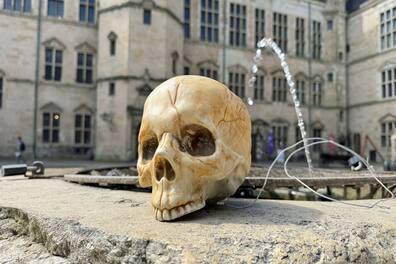
Shakespeare fans know Kronborg Castle as Hamlet's Elsinore. Though the playwright himself likely never visited Kronborg, the castle apparently inspired his famous drama. A decorative skull on a fountain in the castle courtyard serves as a nod to the famous Hamlet scene with Yorick. Throughout the summer, Hamlet performances are regularly held in various rooms.
History enthusiasts will find intriguing details all over the castle: from artful ceiling ornaments and historical furnishings to King Christian IV's (1577-1648) monogram and a massive tapestry depicting the former range of the Danish Empire. However, only one part of the castle survived the devastating fire of 1629 and was subsequently rebuilt: the castle chapel. Services are still held there today.
During a tour of Kronborg Castle, you'll encounter a blend of majestic architecture and military history. The old casemates in the basement are dark, cold-and host a national symbol: Holger Danske, the sleeping hero from Danish folklore. Particularly exciting is a newly designed, interactive exhibition, featuring many hands-on elements that allow you to touch, smell and try out things, from reconstructed feasting tables to chess games as played during Frederik II's time.
The Culture Harbor and the Maritime Museum of Helsingør
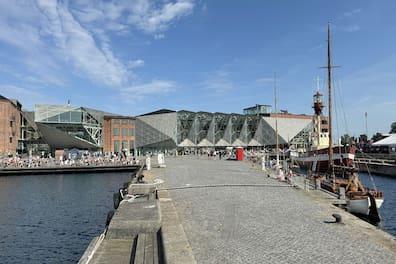
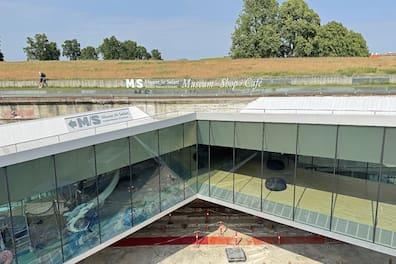
If you're not just interested in Helsingør's well-preserved old townhouses and grand castle, but also in its maritime history, a visit to the Culture Harbor is another highlight. It consists of the so-called Cultureværftet (Culture Wharf)-a modern cultural and event center with a library, concerts, and exhibitions-and the Maritime Museum of Denmark. What's unusual is its location, as it's situated underground in the old dry dock of the former shipyard, which opened in the 1880s.
After the shipyard closed in the 1980s, the site lay fallow, and the Maritime Museum was long housed in the castle-yet had to move out during its bid for UNESCO World Heritage listing. In 2006, an international architectural competition was launched for a new museum building, which the Bjarke Ingels Group (BIG) won. The old concrete walls of the dry dock were preserved, and the museum was placed underground around the old trench. Today, three glass bridges connect the castle and harbor.
Since its opening in October 2013, the museum has depicted Denmark's maritime history from its beginnings in the 15th century to the present. In addition to the two permanent exhibitions, the recently opened Seafarer's Exhibition (from Easter 2025) is a highlight featuring interactive elements: here, you open a treasure chest, feel the sea storm, and discover a giant sail made in Copenhagen. Local artists appear in every era, making it feel like you're aboard an old ship.
If you get hungry during your museum visit, the Værftets Madmarked next door is recommended-a food hall with international cuisine, from Syrian to Italian to Mexican. Amid rustic wooden tables, colorful decor, and humorous wall quotes (e.g., 'Today's Forecast: 99% Chance of Wine'), you sit together convivially.
Looking for more inspiration? Find tips for all the top travel destinations at bettercities.net, and the best travel deals on our deal page.
Travel bettercities.net