 In addition to the famous Azores Islands, which attract thousands of tourists every year thanks to their natural beauty, Portugal also has two other islands that are just as wonderful but often remain in the shadows. We are talking about the Madeira Islands, a natural oasis of rare beauty that promises to give you unrepeatable emotions. Let's discover them together in this guide, which will also tell you everything you should expect in terms of climate and temperatures.
Travel information: useful info
Inhabitants: 267,785
Capital: Funchal
Languages: Portuguese
Local currency: euro
Climate: oceanic, with temperatures between 13° and 25° Celsius
Vaccinations: no vaccination required
Entry requirements: identity card
Distance from Italy: 2,782 km (6-16 hour flight)
Where to find us
The Madeira Islands are located in the middle of the Atlantic Ocean, south-west of Portugal. This archipelago, together with the Azores, the Canary Islands and Cape Verde, forms Macaronesia.
How to get there
From Milan orRome: from Milan and Rome, Lufthansa, Austrian Airlines, Swiss International Airlines and TAP Portugal provide flights to Funchal's Cristiano Ronaldo Airport, which necessarily make a stopover in Lisbon. Flights last between 6 and 16 hours.
Compare flights from Rome or Milan - from €166.00Frommajor European capitals: From London there are flights to the capital of the archipelago, organised by Tap Portugl, British Airways, easyJet and lasting 13-15 hours. There is a stopover in Lisbon for all flights. The same route and duration applies to routes from Paris (Airfrance,Tap Portugl, British Airways, easyJet). From Frankfurt, on the other hand, Condor has direct flights with a duration of around 4 hours.
Compare flights to Funchal - from €128.00
When to go? Info on climate and best time
Month | Average temperatures (min/max) | Rainfall (days/mm) |
|---|---|---|
January | 13 / 19° | 12 days / 105mm |
February | 13 / 19° | 11dd / 85mm |
March | 13 / 20° | 10gg / 65mm |
April | 13 / 20° | 8gg / 40mm |
May | 15 / 21° | 5 days / 20mm |
June | 17 / 22° | 3 days / 12mm |
July | 18 / 24° | 1 day / 3mm |
August | 19 / 26° | 2 days / 3mm |
September | 19 / 26° | 6 days / 35mm |
October | 18 / 24 ° | 9 days / 75mm |
November | 16 / 22° | 11 days / 100mm |
December | 14 / 20 | 13 days / 100mm |
Climate: mild throughout the year, never falling below 13°. This has enabled this archipelago to be known as'the islands of eternal spring'.
Best period: from July to September, when there is less rainfall.
Periodto avoid: best not to go in the months from October to April, when rainfall is more frequent.
Advice: sun cream, mackintosh and hiking shoes are essential.
Which island to go to?
The archipelago consists of 2 main islands: Madeira(or Madeira) and Porto Santo, to which are added 3 other smaller islands that are completely uninhabited and called Desertas and two islands, also uninhabited, called Wild Islands.
Madeira: is the largest island of the archipelago, with a surface area of 741 square kilometres. It is home to its airport, dedicated to its most famous citizen, the footballer Cristiano Ronaldo, and the capital Funchal, rich in tourist facilities.
Porto Santo: The island, located about 50 km from Madeira, has very little to offer compared to the main island. Here, nature is decidedly more barren, given the almost total absence of buildings for its 5,000 inhabitants.
10 things to see: beaches and places of interest
Cathedral of the Assumption of the Virgin Mary: built in the 16th century, it is one of the best examples of Lusitanian sacred architecture in the archipelago. Don't miss its bell tower, cedar, ivory and shell ceilings, and Gothic altar.
Funchal, Zona Velha and Mercado dos lavoradores: the old part of Funchal, once a fishing district, is now one of the main areas of the city, the centre of nightlife and movida thanks to the large number of bars, restaurants and clubs. Equally interesting is the Farmers' Market, that's what its name means, a marvel of scents and colours, now a tourist attraction.
Jardim Botanico and Louro Parque: 3 km from Funchal is the Jardim Botanico, a park of inestimable beauty, containing the largest collection of exotic plants in the world. We are talking about a good 80,000 square metres of greenery with medicinal plants, palm trees and cacti. In the same area you will also find the Louro Parque, a park dedicated to the local avian fauna: parrots and canaries are just two of the many species of birds you will find here.
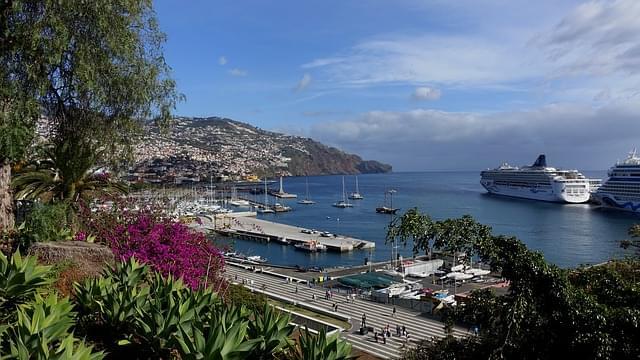
Frente Mar, Jardim Panoramico, Doca do Cavacas and Praia Formosa: In contrast to the unspoilt nature of the hinterland, Frente Mar, Funchal's seafront promenade, is a real exception. In fact, the uniqueness of this area lies in the quantity of hotels that follow one another, interspersed with bars, restaurants and everything that can make a stay in these islands more pleasant for tourists. Noteworthy, in addition to the beach, is the Jardim Panoramico viewpoint, an oasis of peace and greenery in a particularly modern area. Also part of the promenade is Doca do Cavacaz, a group of natural pools of volcanic origin, located just before reaching Praia Formosa, the largest public beach in all of Madeira, actually consisting of 4 different beaches: Praia Nova, Praia Formosa, Praia Dos Namorados and Praia do Areero
Curral dasFreiras and Santana: a few km from the capital is the village of Curral das Freiras. Nestled in the island's volcanic valley, at an altitude of 300 metres, it is rich in chestnut trees, a fundamental source of livelihood for the community. Equally characteristic is the small village of Santana, with its 8,000 inhabitants. Located in the north-eastern part of Madeira, it is famous for its 15th-century stone houses with a distinctive triangular shape, thatched roofs and bright colours.
Porto Santo Beach and Praia le Laje: on the island of the same name, you will find a very long beach, stretching over 7 km and connecting the harbour to Punta da Calheta. If the Porto Santo beach is famous for its light-coloured sand, Praia de Laje, also known as Jamaica, should be noted for its colour: the sand and pebbles that form it are in fact black.
Porto Moniz Pool s: Among Madeira's many natural pools, the Porto Moniz Pools are definitely worth mentioning. Also of volcanic origin, these natural pools can be reached via paths that also offer beautiful views.
Seixal, Chao da Ribeira and Veu de Novia: chosen to be a Unesco heritage site, this area of the Laurissilva fufresta seems like paradise on earth. In addition to dense vegetation, here you will also find streams of clear water, in which trout and many species of birds live. Also in the Seixal area you will find the viewpoint of Veu de Novia, located next to the natural waterfall of the same name.
Funchal Museum of Sacred Art: in this museum are collected the major examples of sacred art of the islands, with a focus on Flemish and Renaissance works
CR7 Museum: Dedicated to its most famous citizen, footballer Cristiano Ronaldo, the CR7 Museum aims to tell the bomber's private and professional story, complete with trophies and awards.
What to do in the Madeira Islands: excursions and tours
How much does a holiday in Madeira cost? Prices, offers and tips
 Madeira is quite cheap, especially when it comes to food. If the costs for a hotel stay are around €70.00 on average, for a day trip you should not spend more than €25.00.
It has to be said that a lot also depends on the area where you decide to stay. The seafront of Funchal, for example, which is full of hotels and tourist facilities, is a very expensive area and therefore not recommended for those who want to keep their expenses under control. When it comes to transport and activities, you have plenty of choice. In Funchal, for example, there is a cable car that takes you to the Monte and Jardim Botanico areas, or you can opt for buses and taxis, which cost €2.70 and €3.70 per ride respectively.
One of the best ways to visit the Madeira Islands, however, is to rely on a tour, especially if you are new to this kind of wandering. Of the many routes available, very few include a transfer from Funchal airport, but rather focus on whale watching tours or inland exploration, costing €16.00 and up.
On the other hand, several solutions can be found that combine flights to the Madeira Islands and accommodation, at very low prices, ranging from €431.00 upwards, updated to February, when costs are lower than in the summer.
Where to stay: Hotels and B&Bs from €22.00 per room
Low cost flights: from €166.00 - look at the offers