 In the heart of Central Asia, at the crossroads of the legendary Silk Road, Uzbekistan is a young country, yet rich in history and culture. Names like Samarkand, Tamerlane and Genghis Khan are known to everyone, for one reason or another. But do we really know how to contextualise them? For instance, the Samarkand sung by Vecchioni where and how do we imagine it?
Once you have landed in this magical country, you will be enchanted and amazed by the beauty it holds in store.
But let us begin the discovery of this incredible culture by starting from Samarkand, perhaps the most famous city!
Travel information: useful info
Inhabitants: about 509,000
Languages: Uzbek, Russian, Tajik, English
Local currency: Uzbek Sum (UZS) / €1.00 = 10,522.40 UZS
Climate: continental, with harsh winters and torrid summers
Time zone: +4 h compared to Italy
Entry requirements: valid passport; visa not necessary for tourist stays of less than 30 days
Security info: there are no particular security risks or problems to report; in any case, it is advisable to consult the Uzbekistan section on the Farnesina website before leaving
Nearest airports: Samarkand International Airport (about 6 km from the centre), Tashkent International Airport (316 km away, about 2 hours by super fast train)
Choose travel/health insurance: with us you get a 10% discount and have full cover, 24-hour medical insurance and unlimited telephone advice
Location
Samarkand is the second largest city in Uzbekistan and is located in the Zeravshan River Valley in the centre of the country. It is more than four hours by car from the capital Tashkent.
How to get there
Rossija Airlines connects Milan or Rome to Samarkand International Airport with 10-hour flights that include a stopover in Russian cities such as Moscow or St Petersburg. Usually Samarkand is included in a full Uzbekistan itinerary, so you might prefer to land in the capital Tashkent and then move overland to Samarkand, taking advantage of the super-fast trains (Tashkent-Samarkand, 2 hours, €13.00)
When to go? Info on climate and best time
Month | Average temperatures (min/max) | Precipitation (days/mm) |
|---|---|---|
January | -2 / 7° | 7 days / 37 mm |
February | 0 / 9° | 9 days / 53 mm |
March | 4 / 14° | 10 days / 59 mm |
April | 9 / 21° | 9 days / 63 mm |
May | 14 / 26° | 6 days / 35 mm |
June | 17 / 32° | 4 days / 14 mm |
July | 19 / 34° | 0 days / 2 mm |
August | 17 / 33° | 0 days / 0 mm |
September | 13 / 28° | 1 day / 2 mm |
October | 7 / 22° | 3 days / 22 mm |
November | 3 / 15° | 3 days / 26 mm |
December | 0 / 9° | 6 days / 42 mm |
Climate: continental, with cold winters and torrid summers
Best time of year: best during spring and autumn (April to May and September to early November). During these months, the climate is particularly enjoyable.
Period to avoid: there is no real period to avoid. From December to February it can get very cold, but if the low temperatures don't scare you, go ahead.
What to see and do in Samarkand
1 - Registan Square
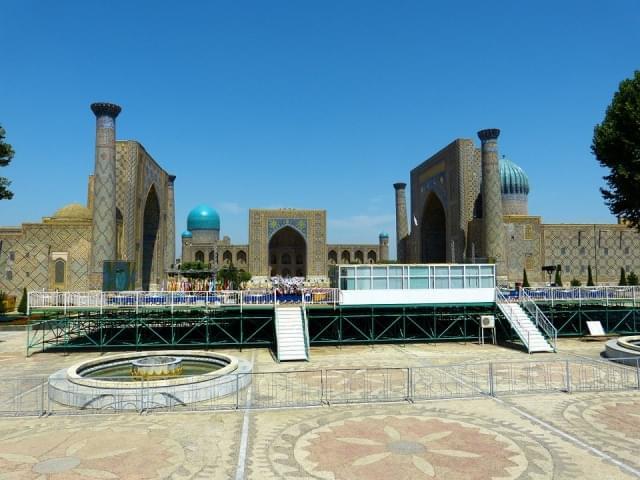 In the heart of Samarkand, stands the majestic Registan, one of the most beautiful buildings of the world's Islamic architectural heritage. Registan Square literally leaves you ecstatic. It is also very impressive at night when it is illuminated. WARNING: when taking night photos, be aware that the lights go out at 22:00!
The construction of this marvellous complex is owed to Ulug Beg, grandson of Tamerlane, who, in 1417, started the design of the square with the construction of the first madrasa on the western side of the area. 200 years later, Governor Yalangtush Bahadur, had two more Koranic schools built, giving rise to this unusual architectural arrangement of two madrasas facing each other plus a third.
The term Registan means'the place of sand' and, in fact, before the October Revolution in 1920, the square was a busy and bustling bazaar, a strategic hub of the Silk Road. The Bolsheviks, however, moved the market to use the square as a venue for rallies, military parades, ceremonies and public trials.
How to get there: hub and heart of Samarkand, centrally located; perfect starting point for exploring the city
Hours: always accessible
Ticket price: Free
2 - Madrasa of Ulug Beg
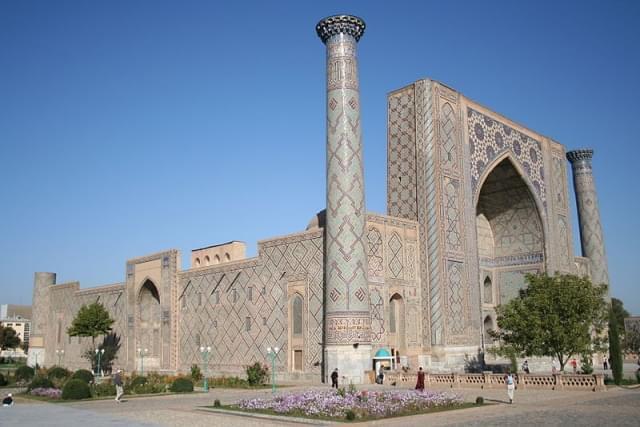 On the west side of Registan Square, the Madrasa of Ulug Beg, theoldest in the complex (1417-1420), was completed when the famous king and astronomer who commissioned it was still alive. It is one of the most important and impressive Koranic schools in Central Asia, with a rectangular floor plan measuring 80 metres x 60 metres.
The monumental entrance features a pishtaq over 16 metres high and decorated at the apex with mosaics depicting stars, violets and turquoises on a light background (an explicit homage to the passions of Ulug Beg). On the sides, a triple order of arched niches enhances the verticality of the construction also accentuated by the towering minarets. What is impressive is the fact that the walls, both inside and outside the building, are completely covered with ceramic tiles.
The school, with about 36 rooms, was able to accommodate about seventy students who, in addition to studying theology, had the opportunity to study physics, mathematics and astronomy. Disciplines that Ulug Beg himself taught there.
Directions: on the west side of Registan Square
Hours: 9 a.m. to 6 p.m.
Ticket price: €6.00 (single ticket for all 3 madrasas)
3 - Madrasa Shir Dor
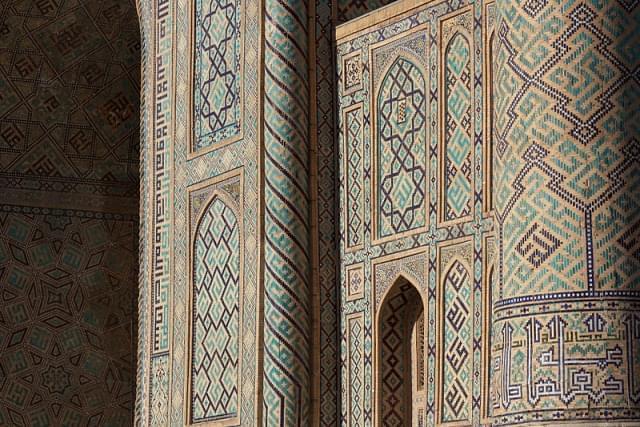 Built between 1619 and 1636, the Shir Dor Madrasa was designed with the intention of mirroring as closely as possible that of Ulug Beg, which stands directly opposite it.
The uniqueness of this madrasa lies in the fact that it breaks the Islamic prohibition against depicting living beings. The tympanum, in fact, is decorated with two mirror images depicting a feline (more specifically a lion with a tiger-like coat) chasing a deer, under the inscrutable gaze of a sun with a human face. The interpretation of this iconography sees in the feline the power and virility of the emir who, under the divine protection radiated by the sun, manifests his authority over the conquered peoples, symbolised by the fragility of the herbivore.
The façade is also characterised by its turquoise, ribbed and resplendent side domes. Both the interior and exterior walls are decorated with majolica and mosaics rich in floral and geometric motifs and calligraphic borders.
Directions: on the east side of Registan Square
Hours: 9:00 am to 6:00 pm
Ticket price: €6.00 (single ticket for all 3 madrasas)
4 - Madrasa Tillya Kari
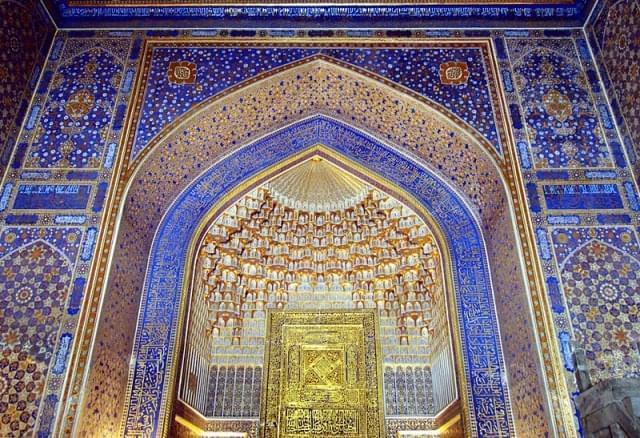 Situated between the other two, the Tillya Kari Madrasa was built in 1646 by Yalangtush Bakhadur with the precise intention of "closing off the square" by filling the space between the two madrasas already completed.
The decorative motifs recall and are very similar to those of the Shir Dor Madrasa, but it is the interiors of the Tillya Kari that leave the spectator speechless. Tillya Kari, literally, means'covered in gold'. And this is no accident. In fact, the mosque inside the madrasa has its ceilings completely covered with gold leaf.
Directions: on the north side of Registan Square
Hours: 9am to 6pm
Ticket price: €6.00 (single ticket for all 3 madrasas)
5 - Bibi-Khanum Mosque
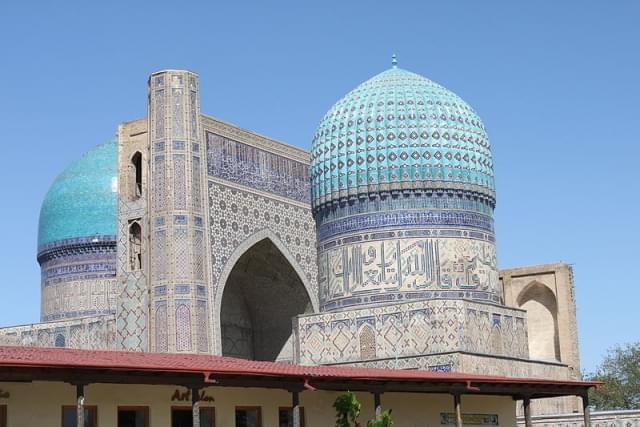 Built in the early 1400s by Tamerlane in honour of his favourite wife, it was one of the most impressive mosques in the Islamic world.
A grand mosque with a capacity of about 12,000 people built with the riches derived from the looting of Dehli.
It collapsed in the earthquake of1897 and to this day has only been partially restored.
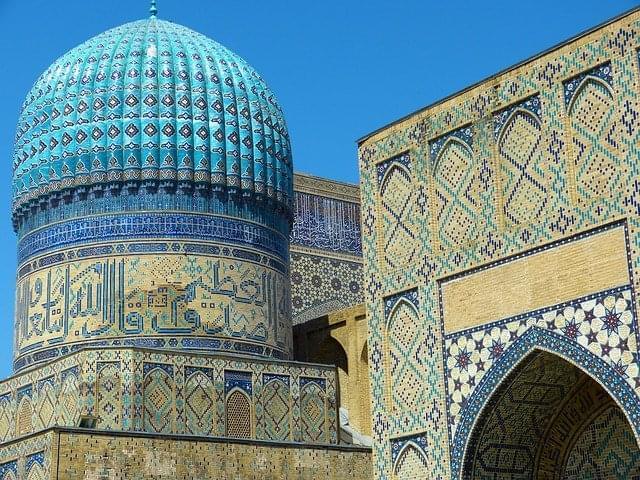
Magnificent domes embellished with blue-tinted mosaics and the entrance gate can be seen.
Passing through the entrance, one enters a large courtyard with a huge lectern in the centre where the golden Koran was placed during ceremonies.
Legend has it that if a woman crawls under the lectern she will have many children.
Directions: on Bibikhonim St; 1.1 kilometres from Registon Square, a 13-minute walk
Hours: April to October 8am to 7pm; November to March 9am to 5pm
Ticket price: €0.90
6 - Shah-i-Zinda Complex
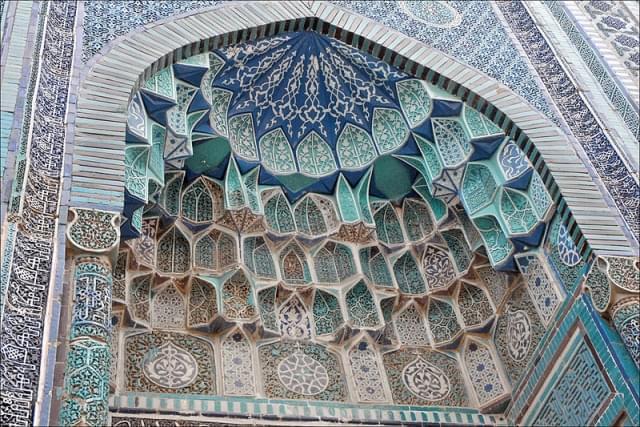 The Shah-i-Zinda complex of mausoleums is a vast funerary complex erected by Tamerlane for the women of his family. In addition to his wives, aunts, nieces, cousins and his nurse are buried here.
Thecity's, if not Uzbekistan's,main pilgrimage destination, it takes the form of a long avenue lined, on both sides, with mausoleums, one more beautiful than the other. The overall view leaves one speechless. The artistic refinement and flair of those who put their hand to it is clearly evident: in fact, each mausoleum is different from the next, although there is an overall harmony.
Themost beautiful tomb, according to most, is that of Sha-di Mulk Aka (the first Timurid-style structure built in Samarkand) where two of the leader's granddaughters rest and on which there is the inscription'Here was lost a precious pearl'. By contrast, the largest tomb is the Qazi Zadeh Rumi mausoleum. Dating from 1420 and with two domes, it houses the remains of Tamerlane's wet nurse.
How to get there: by M-37, Samarkand; 1.5 km from the Bibi-Khanum complex, a 20-minute walk
Hours: 7am to 7pm
Ticket price: €1.00
7 - Mausoleum of Gur-i-Amir
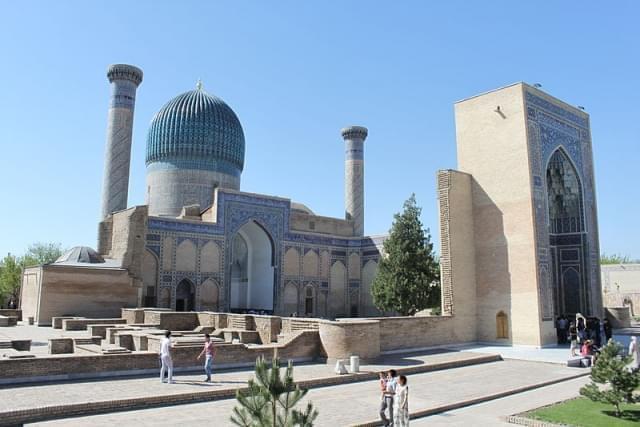 It is certainly not the most visited monument in the city but it is worth a visit for what it holds, for its history and above all for its architectural beauty.
This small mausoleum can be seen from afar thanks to its splendid dome decorated with as many staircases as the years of Tamerlane who is buried inside.
Along with Emir Tamerlane, the mausoleum holds the graves of some of his sons and grandsons and also his master.
The interior is completely covered with rich gilded decorations and the tombstones are arranged around that of the emir.
We recommend visiting in the evening, when the light can bring out the beauty of the building and its architectural lines.
Directions: 1/4, Universitetskiy Boulevard Bustonsaroy St; 1 km from Registan Square, a 13-minute walk
Hours: 9:00 a.m. to 6:00 p.m.
Ticket price: €0.90
8 - Siyob Bazaar
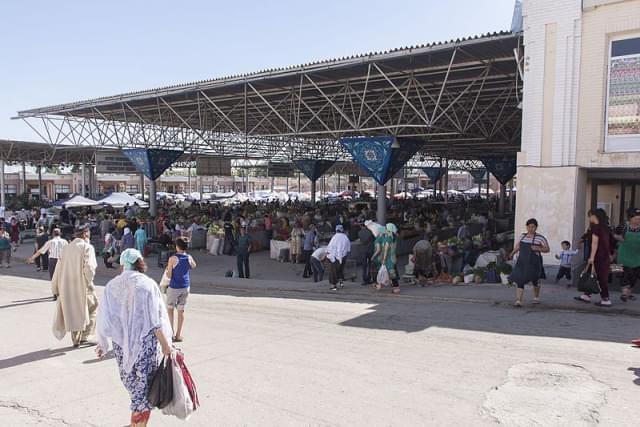 Adjacent to the Bibi Khanym Mosque, the colourful and bustling Syyob bazaar is the largest market in Samarkand, frequented daily by locals.
Under a sheltering structure, there are long rows of neatly arranged stalls selling mostly foodstuffs. As is the practice in the Middle Eastern tradition, here too one can distinguish the various sectoral areas selling specific products: fruit and vegetables, dried fruit and various sweets, spices, bread, household items, etc.
As well as a break from history and culture, a tour of the market allows you to see a glimpse of local life at close quarters. The Uzbeks are very affable and hospitable, recognising you as tourists, they will continually ask you where you come from and proudly offer you samples of their typical products, primarily seeds and dried fruit, but also nougat and chocolate. A riot of colours and scents, where you can take beautiful photographs!
Directions: on Bibikhonim Str, right next to the Bibi-Khanum complex; 1.1 kilometres from Registon Square, a 13-minute walk away
Hours: 8am to 6pm
Ticket price: free
9 - Ulugh Beg Observatory
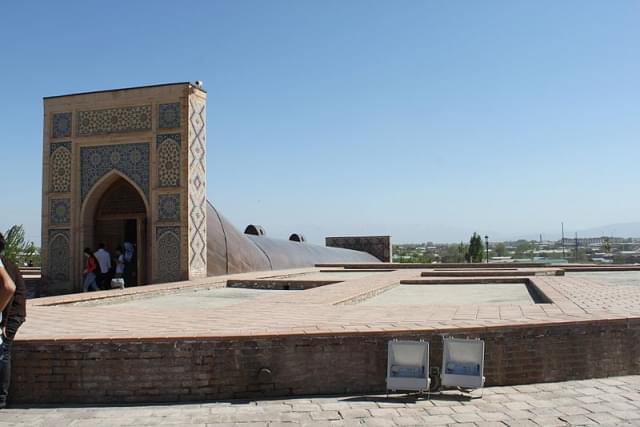 An astronomical observatory on the outskirts of Samarkand, built in 1429 by the Timurid prince and astronomer Ulugh Beg, grandson of Tamerlane, and one of the best observatories in medieval Islam.
Inside, there is a sextant of about 30 metres that was used to measure theposition of the stars and a very large arc that was used to determine noon.
A few years after its construction, it was destroyed and it was not until the early 1900s that work began on exhuming the place.
In 1964 it was inaugurated together with the smallMemorial Museum inside, which houses tools, implements and miniatures of fundamental importance for understanding the discoveries that had been made.
How to get there: on Tashkent Rd, 6 km from the city centre, reachable by taxi in about 10 minutes, average cost for a ride about €2.00
Hours: April to October from 8am to 7pm, November to March from 9am to 5pm
Ticket price: €2.30
10 - Afrasiab Museum
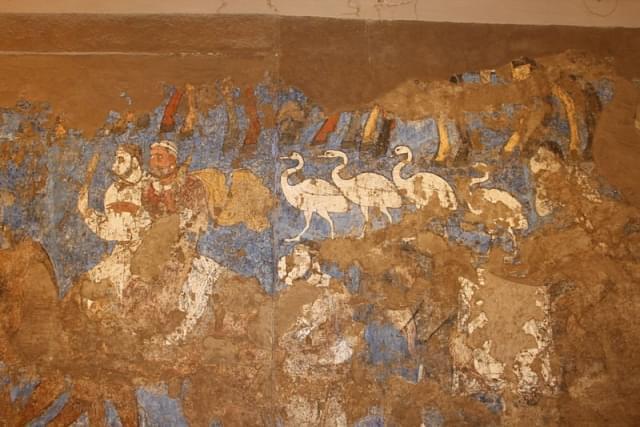 To learn more about the history of the country, it is worth visiting the History Museum in Afrasiab (2 km from the centre), theancient city that was destroyed by the Mongols in the early 13th century.
In the five rooms of the museum, through remains, artefacts, manuscripts and sculptures, the history of the founding of Samarkand is shared and retraced, a history of settlements and invasions but also of glory and prosperity.
The building that houses the museum was designed by Armenian architect Bagdasarov Arzumanyan in 1970 and theopening of the museum was dedicated to the 2500th anniversary of the founding of the city of Samarkand.
There is a permanent exhibition focusing on the history of the city itself and the surrounding region.
How to get there: on Tashkent Rd, 1.5 kilometres from the Ulug Begh Observatory, a 15-minute walk away
Hours: 8:30 am to 6:00 pm
Ticket price: €2.30
How much does it cost to visit Samarkand? Prices, offers and tips
Uzbekistan is a young country that is opening up to tourism with great dynamism and zest.
Being in the early stages of tourism there are still few local agencies, the easiest thing is to book a package with a tour operator from Italy. However, if you want to undertake an experience on your own, it is a safe country with hospitable people ready to lend a hand.
The hotels are good, comfortable and moderately priced. A simple 3-star can easily be equated to an Italian 4-star. It is a clean and well-organised country; quiet and without any particular dangers.
Cheap flights: from €305.00 - see offers
Where to stay: Hotels and B&Bs from €41.00 per room - look at the offers
Flight+ hotel: A/R flight + 7 days/6 nights from €762.00 per person - look at the offers