The long stretch of sea and the leafy Collserola mountain range mark out the city and serve as an orientation for getting around it. The "sea side" or the "mountain side", say the locals when they give an address. Because that's what it's all about, going up or down, and in the meantime discovering the different historical and artistic layers that have forged the city.
There's no better way to start the day in Barcelona than by stretching your legs along its seven kilometres of urban beach: from the Hotel Vela to the Fòrum, via Port Vell and Port Olímpic, stopping at any of its beach bars to enjoy its exhilarating mix of locals and foreigners sunbathing or playing sport at any time of day. With more than 300 days of sunshine a year, the golden sand covers what until before the 1992 Olympics was a decadent industrial area.
Renewed through the complicity of urban planners and citizens, Barcelona is still alive in the streets, which are always furnished with the latest furniture and attentive to detail. People of all ages pass - no matter the time - between avant-garde buildings that are now architectural classics, attend experimental theatre or the opera season, the largest football stadium in Europe or the smallest and most seductive tapas bars.
After twenty centuries of history, the city has achieved a balance that the world appreciates and the people of Barcelona maintain, adapting their Mediterranean lifestyle to the dynamism of an innovative economy with efficient infrastructures and services. The "Barcelona 21st century" recipe attracts twenty million visitors a year and the number continues to grow, so while Rome, Berlin, Paris or New York spend fortunes promoting tourism, Barcelona tries to contain it to prevent it from displacing residents and distorting its identity.
The city from above
To begin to integrate into this balance, you have to contemplate it from above and look out over the Mediterranean: to your back is the mountain; to the left, the river Besós; and to the right, the Llobregat. If you get your bearings, you are already a Barcelonian. If you get disorientated wandering the streets, look back to the sea. Its humid breeze is felt on your cheeks during the day, just like the dry inland air at night. The sea opens up the city and explains its discreet diligence, so different from the hustle and bustle of other capitals. The people of Barcelona don't want to rush, but they don't waste time either. He appreciates its "anar fent" (in Catalan, "going about doing"); flowing without exaggeration.
Once you've got into the rhythm, it's time to enjoy the best view: the one you get from the hundred-year-old Tibidabo Amusement Park. It's worth a stroll to enjoy the panoramic view and its decadent charm. Another way to gain perspective is to mingle with the tourists at the top of Gaudí's Parc Güell, or to look out from one of Tibidabo's viewpoints with a well-served bar, perhaps the Mirablau.
We are on the threshold of the Collserola natural park, the city's great green lung, which the people of Barcelona walk, run, cycle or horse ride along dozens of well-marked paths and trails through its dense Mediterranean forest. The Carretera de les Aigües - a completely flat dirt track - is its best walk, a delightful natural balcony. From any of its viewpoints you can make out the mesocratic soul of the city, embodied in the great Cartesian grid of the Eixample, prolonged in the Olympic Village. Barcelona's renewed skyline shows its most classic and newest icons: the towers of Gaudí's Sagrada Familia, Jean Nouvel's bluish glass torpedo, the bell towers of the Cathedral and the Gothic church of Santa Maria del Mar and, in the background, the twin towers of the Olympic Port.
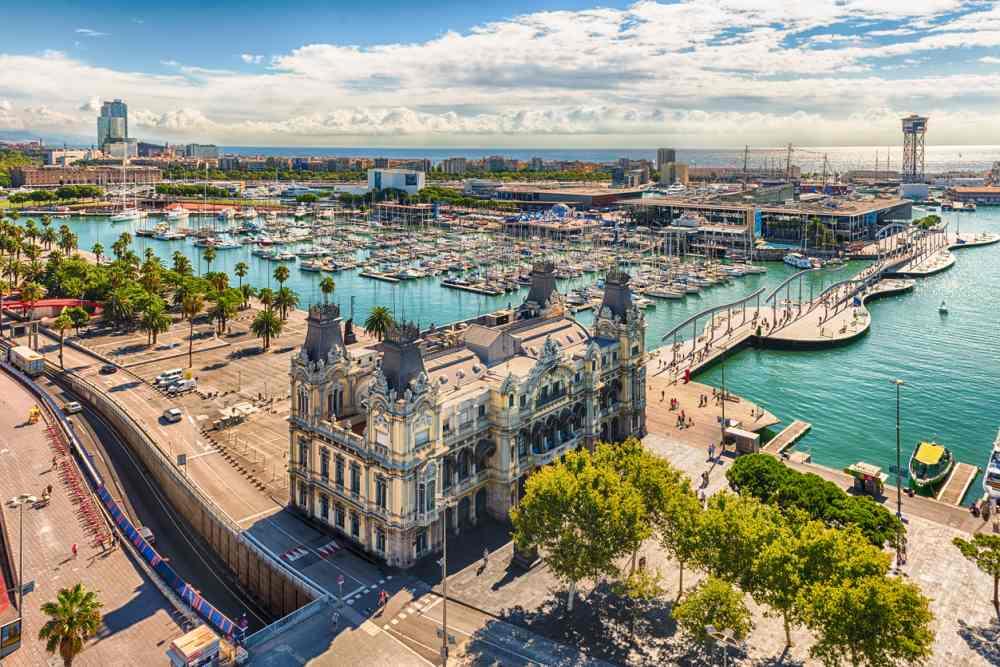
To the right of this panoramic image rises the mountain of Montjuïc, the other great urban lung, with the Olympic Stadium and the military castle, from where the city was bombarded to quell popular uprisings. Below the fortress, on the other side of the cables of the cable car that flies over the mountain, lies Barcelona's port, one of the busiest in the Mediterranean.
The route from the Tibidabo mountain to the beach crosses the city from one end to the other and takes barely two hours to complete. The fact is that the cosmopolis, in love with its new balance, is reluctant to lose its human dimensions, perhaps because it prefers to make a good impression rather than to impress. On the way down, you pass through neighbourhoods that retain the independent character they had before Barcelona knocked down its medieval walls and expanded.
The mixture of spaces and uses is also part of Barcelona's balance, something that has been extended to its remodelled markets, which now not only invite you to shop but also to stroll around and taste a cuisine that is proud to call itself "market cuisine". It is a delight to enter and enjoy the activity, colours, flavours and smells of El Ninot, La Llibertat and Santa Caterina, the most central ones, although La Boqueria, in the middle of Las Ramblas, is still fascinating, even if it is flooded with tourists.
Gaudí presents Barcelona to us
On either side of Avinguda Diagonal - now transformed into an 11-kilometre promenade from Pedralbes to the Fòrum beaches - the Eixample grid opens up. On Passeig de Gràcia, an elegant boulevard lined with luxury shops, you can see two Gaudí queues: La Pedrera on the left and Casa Batlló on the right. Both form part of the so-called Quadrat d'Or, a group of blocks containing essential buildings of Catalan Modernisme, commissioned by bourgeois families in the 19th century. Of particular note are the Casa Amatller, by Puig i Cadafalch, and the Casa Lleó Morera, by Domènech i Montaner.
If we "anem fent" (let's go downhill), in ten minutes we are on the Ramblas, where there are many people but few locals. No matter: it is the most fascinating way to reach the statue of Columbus and the sea at the Port Vell. At that height is the Drassanes building - today the Maritime Museum - an imposing vestige of the city's medieval and maritime past.
The city wants to remain Barcelona, but without renouncing to being cosmopolitan, which is why it combines all the cultures and schedules of the planet for eating, sleeping, drinking and dancing, but giving them a genuine and local interpretation. Alongside Barcelona's 14 Michelin-starred restaurants, others such as Il Giardinetto, Ca l'Isidre, el Suculent or el Xemei, la Taverna del Clínic or el Cañete offer incomparable experiences; generous in distinctive culinary excellence and flexible in price.
To feel unique again after the human torrent of the Ramblas, you have to lose yourself in the network of narrow streets of the Ciutat Vella and the Born, the historic centre of the capital, now gentrified and rehabilitated, but still with medieval charm, like the Cathedral and its great esplanade, always alive. On the way, it is worth stopping off at quiet, secluded spots such as the Plaça del Pi and the church of Santa Maria del Pi, whose acoustics make for splendid classical music concerts.
Nearby is the Basilica of Santa Maria del Mar, built stone by stone by merchants and shipowners 800 years ago to offer us today one of the most balanced experiences in space and light of European Gothic architecture. The basilica is still the favourite of Barcelona's bourgeoisie for their weddings, which have been increasingly disturbed by the flood of visitors unleashed by the novel La Catedral del Mar, by Ildefonso Falcones. It is surrounded by narrow, lively alleyways that lead to the Paseo del Born and then to the Ciutadella park, a military citadel after the defeat of Barcelona in 1714 at the hands of Philip V and the brand-new site of the Universal Exhibition of 1888.
Back on the Ramblas, the Liceu offers in its Cercle - a private club dating from 1847 - the epiphanic experience of contemplating La Rotonda hall, decorated with paintings by Ramon Casas, the painter who best evokes the nineteenth-century splendour of Barcelona's plutocrats. Its operas and the concerts at the Palau de la Música -another Modernista treasure-, just a few crossings away, concentrate the city's lyrical offerings, while the Picasso Museum, the Museum of Contemporary Art (MACBA) and the galleries around the Convent dels Àngels present the latest in design. The MACBA square has also become a mecca for skateboarders from all over the world.
Neighbourhoods with character
If you already know the centre of Barcelona, choose one of its neighbourhoods and explore it. These are other Barcelonas with their own personality, unforgettable terraces, the flavour of an old neighbourhood and lifelong residents. It could be the maritime district of Barceloneta, perfect for a vermouth in front of the sea. Or the alternative neighbourhood of Gràcia, where you can feel part of the urban tribes from all over Europe that have made it their utopia. Its squares, and especially the Plaça del Diamant from Mercè Rodoreda's novel and her film, are the best bridge between the past and the present of popular culture, where Esperanto began to be spoken so that today its athenaeums, associations and theatres - the Lliure remains at the forefront of the international scene - remain faithful to their revolutionary tradition.
For the dancing night, there is Carrer Tuset and the temple of forty-somethings with rhythm, Luz de Gas. Or the bohemian corners of Plaça Reial, such as Ocaña or Marula. At this time of day, there may not be long before dawn breaks and Barcelona shows us new secrets.