 Known as the'Hawaii of Europe', the Azores Islands are the ultimate expression of what nature is capable of, if left free to express itself. The archipelago, consisting of 9 islands, attracts tourists from all over the world, who want to visit its shores and hike among their unspoilt nature. Although they are very close to Europe, visiting them can be difficult if one does not know what to expect. Here, then, is our guide to the climate, temperatures and what to see in the Azores Islands.
Travel information: useful info
Inhabitants: 246,746
Capital: Ponta Delgada
Languages: Portuguese
Local currency: euro
Climate: oceanic climate, temperatures between 10° and 25° throughout the year
Vaccinations: no vaccination required
Entry requirements: identity card
Distance from Italy: 3,269 km (6-15 hour flight)
Choosetravel/health insurance: with us you get a 10% discount and comprehensive coverage, 24-hour medical insurance and unlimited telephone advice - get a free quote
Where to find us
The archipelago of the Azores Islands lies to the west of Portugal, a state of which it is politically a part. Bathed by theAtlantic Ocean, the 9 islands that form it are characterised by dense vegetation, born of their volcanic origin.
How to get there
FromMilan or Rome: there are no direct flights from Rome. TAP Portugal's direct flights to Ponta Delgada have a stopover in Lisbon. The total travelling time ranges from 8 to 12 hours, but from Lisbon to Ponta Delgada only takes 2 hours. The route from Milan to Ponta Delgada is the same as above.
Compare flights from Rome or Milan - from €169.00From major European capitals: TAP Portugal also connects Ponta Delgada with London, with flights ranging from 6 to 18 hours, generally with only one stopover in Lisbon. The same route is also available for flights from Paris, with journeys offered by SATA International-Azores Airlines ranging from 6 to 24 hours in total, and for those from Berlin. The latter, operated by TAP Portugal, connect Berlin to the Azores with a journey time of 8 to 20 hours in total.
Compare flights to the Azores - from €53.00
When to go? Info on climate and best time
Month | Average temperatures (min/max) | Rainfall (days/mm) |
|---|---|---|
January | 12 / 17° | 12 days / 120 mm |
February | 11 / 17° | 10 days / 100 mm |
March | 12 / 17° | 12 days / 105 mm |
April | 12 / 18° | 9 days / 65 mm |
May | 13 / 20° | 7 days / 60 mm |
June | 15 / 22° | 4 days / 40 mm |
July | 17 / 24° | 3 days / 25 mm |
August | 18 / 26° | 4 days / 30 mm |
September | 18 / 25° | 8 days / 80 mm |
October | 16 / 22° | 9 days / 105 mm |
November | 14 / 20° | 11 days / 120 mm |
December | 13/ 18° | 14 days / 100 mm |
Climate: oceanic, with mild temperatures throughout the year, interspersed with periods of heavy rainfall and cyclones.
Best period: April to September, with a preference for July and August.
Period to avoid: the autunnal months are not suitable for visiting the Azores, due to the high possibility of heavy rainfall and cyclones.
Advice: it is best to always have a mackintosh and a heavier, long-sleeved garment at hand, given the sudden change in temperatures throughout the year.
Which island to go to?
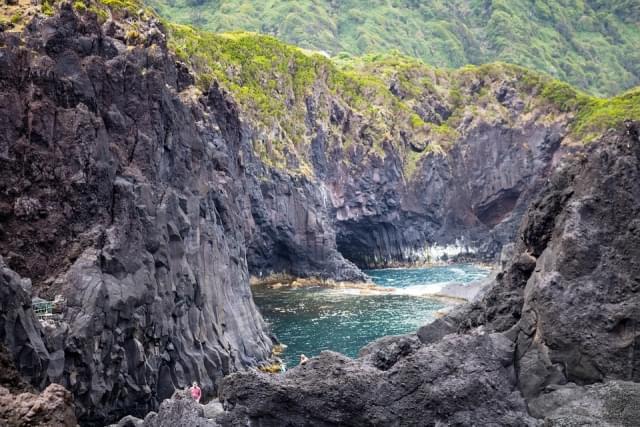 The archipelago consists of 9 islands, all of volcanic origin: Sao Miguel, Santa Maria, Sao Jorge, Corvo, Flores, Faial, Pico, Graciosa and Terceira.
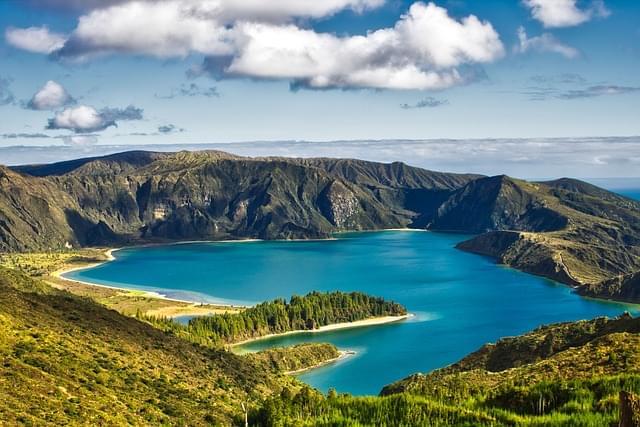
Sao Miguel: is the main island of the Azores, home to the international airport and the capital city, Ponta Dalgada. Rich in cultivated fields and greenery, it is famous for the Lago del Fuoco, one of the most characteristic volcanic lakes in the area.
Santa Maria: this is theyellow island of the Azores, where green is not so common. Here one finds the red desert, so called because of its reddish soil.
Terceira: a symbol of the contrast between nature and architecture, Terceira is characterised by a Renaissance style, visible in the historic centre of the capital Angra, which earned it a place on the World Heritage list in 1993.
Graciosa: characterised by a predominantly flat terrain, it is full of contradictions, as can be seen in its highlights, from the windmills of Praia to the thermal baths of Carapacho.
Sao Jorge: with its characteristic shape, long and narrow, it looks like a lying dragon. Its peculiarity? Apart from being a favourite destination for trekkers, it is also home to a large number of cows.
Faial: the westernmost island of the Azores, it is inhabited by about 15,000 people, 6,000 of whom are in Horta, its main centre. Here is the Peter Café Sport, the most famous bar in the Atlantic Ocean, where sailors, divers and whale hunters meet.
Flores: known to be the island of flowers, Flores is characterised by endless fields of hydrangeas and azaleas, so characteristic of this small island.
Pico: home to the third highest volcano in the Atlantic, it is the site of important dive sites, such as Grotta das Torres, the largest lava tunnel of all the Azores islands.
Corvo: the smallest island of the Azores, is now a UNESCO Biosphere Reserve. It is an essential stop for trekking and nature lovers, who will find plenty to do here.
11 things to see: beaches and places of interest
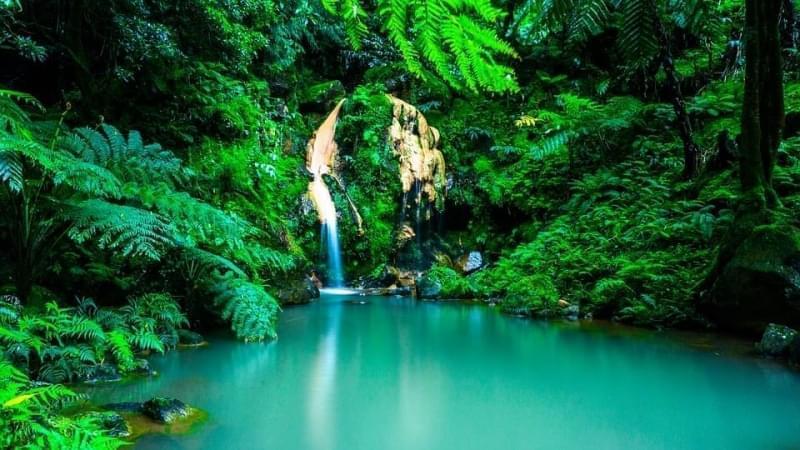
Sete Lagoas: Located on the island of Flores, these seven mountain lakes are one of the island's main attractions, along with Morro Alto and the Riverida do Ferreiro waterfalls.
Furnas: on the island of Sao Miguel, a famous location with sulphurous springs, all around a lake of the same origin.
Praia Formosa: located on the island of Santa Maria, it is the only beach to have light-coloured sand, as opposed to all the others that have shades of colour ranging from grey to black, precisely because of their volcanic origin.
Farol de Gonçalo: located a stone's throw from Praia Formosa, this lighthouse is one of the area's major attractions. Its position, overlooking the ocean, offers splendid views to those who decide to visit it.
PicoVolcano: On the island of Pico stands the volcano of the same name, which is 2,351 metres high, making it the third largest volcano in the Atlantic.
Furna do Enxofre: The cave, located on Graciosa Island, provides access to Lagoa do Styx, a small lake of volcanic origin that lies below sea level.
Historic Centre of Santa Cruz: elegant and refined, it was built between the 16th and 19th centuries and is still famous for its characteristic houses, which make their way through cobbled alleys.
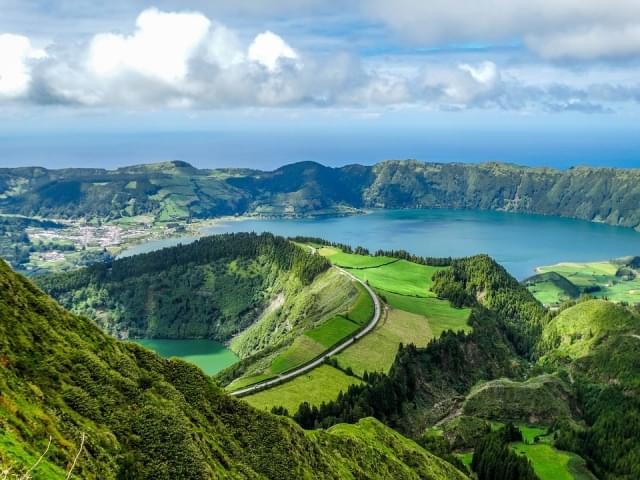
Sete Cidades: this is a caldera on the island of São Miguel inside which flows Lagoa do Canàrio, a volcanic lake with strong green and blue colours. Ideal for kayaking while admiring the forest all around.
Mato José do Canto: On the island of Sao Miguel you will find this beautiful garden, which runs along the entire south-western coast of Lagoa das Furnas.
Miradouro Vista do Rei: inaugurated in the early 1900s, after the sight of King Charles I, this viewpoint on the island of Sao Miguel is one of the most famous places on the island.
Caldeira Velha: on the north coast of São Miguel, this is a natural thermal park with two natural pools, one smaller and the other larger, with thermal water at a temperature of around 37°C. All around the park is a lush exotic garden, but equipped with showers, baths and changing rooms for thermal activity.
What to do in the Azores: excursions and tours
How much does a holiday in the Azores cost? Prices, offers and tips
 The prices for a stay in the Azores Islands are perhaps high, but in line with those we would find in Portugal. We are talking about €50.00 per night and €30.00 for food. The lion's share is certainly the flights and excursions. From Italy, in fact, flights are around €200 per person, and even excursions and guided tours hardly drop below €50 per person.
Where to stay: Hotels and B&Bs from €24.00 per room - see offers
Low cost flights: from €169.00 - look at the offers
Flight + hotel: 7 nights/8 days from €490,00 per person - look at the offers
Personalised quote: click here to request a personalised quote
Travel insurance: our advice
We always rely on the company  which provides comprehensive cover at absolutely competitive prices.
They also providecustomer service, an always active call centre and24-hour medical insurance with unlimited telephone medical advice: we know that when you are abroad in emergency situations, finding an advisor who is always ready to respond is the most important thing.
Visit their website and receive a 10% discount on your policy reserved for Travel365 users.