After High School: Comparing Work and Travel, Internships, and Au Pair Abroad
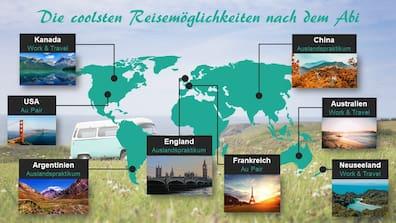
You've got your high school diploma and you're eager to go out and enjoy freedom, after roughly 13 years of schooling.
We understand that and here are the coolest travel opportunities after graduation.
1. Work and Travel
Work and Travel is primarily about financing your stay through various jobs along the way. Few options offer as much freedom and flexibility as this. You are your own boss and decide for yourself how long you stay in one place and where the journey goes next.
Requirements for Work and Travel:
To participate in the Work and Travel program, you need a 'Working Holiday Visa', allowing you to take up casual jobs in the respective country for up to twelve months. When applying, you must be between 18 and 30 years old. Under certain conditions, the visa can also be extended.
In Australia for example, you can extend it by another twelve months, and in New Zealand by three months. For this, you must have worked as a seasonal worker for a certain period (about three months) during your initial stay.
Of course, you can also complete a Work and Travel year in EU countries. In that case, no visa is necessary.
Popular Destinations for Work and Travel:
More than half of the globe-trotters head to Australia and New Zealand - top places for Work and Travel. This is certainly due to the fact that both countries shine with exotic flair, beautiful beaches, and natural spectacles.
Places like the Australian Great Barrier Reef and the Great Ocean Road or the Milford Sound Fjord in New Zealand attract young adults.
In third place among the most popular countries for globetrotters is Canada. Approximately 16 percent of Work and Travel travelers head there annually, drawn by the numerous clear lakes and rivers, secluded coniferous forests, and mountain landscapes.
Costs of Work and Travel:
Work and Travel trips are usually expensive. However, what matters most is how balanced the ratio of 'Work' and 'Travel' is for the respective traveler and what kind of pay is offered.
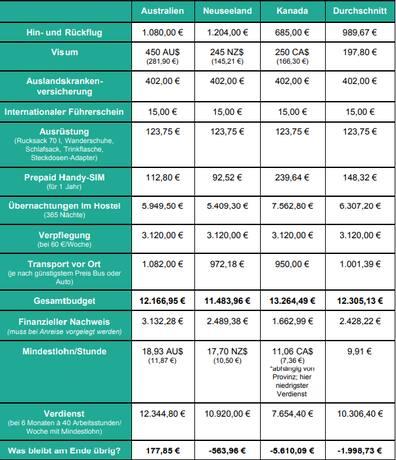
Travelcircus has compared the costs of the three most popular countries in a comparison overview including pre-departure costs, local prices, and minimum wage.
Although flight tickets and transportation in Canada are cheaper compared to other countries, a stay in Canada can end up costing about ten times more than a trip to New Zealand.
Why is that? Due to the minimum wage, which is much lower in Canada than in Australia and New Zealand, and stands at 7.36 euros per hour.
Advantages of Work and Travel:
The level of independence is particularly high with this type of travel because with Work and Travel you can arrange your time according to your preferences and are not tied to any place. Additionally, you meet many like-minded people and locals while working and traveling.
Disadvantages of Work and Travel:
You need a certain amount of start-up capital for your journey and rely on getting jobs.
2. Au Pair

If you want to dive directly into the life and culture of another country, you can do so by becoming an au pair. Staying with a family in the country of your choice, you can quickly get a sense of the country's mentality, become part of a family, and earn money on the side.
In general, you have two options for an au pair stay: either you find a family on your own, or you involve an agency that mediates between you and the host family and is always available as a point of contact.
In some countries, like the USA and Switzerland, an au pair stay is only possible through an agency that provides you with the necessary work visa. Popular providers include AIFS and TravelWorks.
However, there are also some portals where you can contact families in other countries yourself, and where stays of less than six months are possible. Such as the portal aupairworld.com. Here you can find families from all over the world looking for an au pair.
Requirements for Au Pair:
Most agencies offering au pair stays require you to meet certain criteria. The following illustration shows which ones.
In addition to the points mentioned, you also need a so-called J1 visa for the USA, which is valid for twelve months and allows you to work and attend university in the country.
Popular Destinations for Au Pair:
English-speaking countries are particularly popular, which is not surprising, as English is taught from elementary school, making it easier for many people to speak the language. Apart from countries like Canada, New Zealand, England, and Ireland, the USA is also at the top of the list.
During a stay in the USA, you can even get a taste of university life. In addition to childcare, au pairs attend a course at the local university for about three hours a week.
But France is also a popular country and particularly appealing to German au pairs, as no visa is required for entry. The country also has a lot to offer: city vibes in Paris, rugged nature in Brittany, and southern flair on the French Riviera.
Costs for Au Pairs:
On average, you should budget around 700 euros for agency fees. These often include flight and insurance, such as travel health insurance. It's best to compare the different providers with each other.
The host family then covers accommodation and meals. In return, you take care of the children and possibly the household and receive additional pocket money weekly.
In the USA, it's generally about 174.61 euros converted for 45 working hours a week. You have 1.5 free days per week plus ten vacation days a year. This would amount to an annual amount of 9,079.72 euros at the mentioned salary. A study grant of 500 US dollars is also added on top, allowing you to attend the weekly college course.
In France, you earn an average of 65 to 90 euros for a 30-hour week with one free day. In France, you also have the option of only staying with a family for three months, over the summer holidays.
Advantages for Au Pairs: You can immerse directly into the life and culture of a family from a foreign country and earn good money on the side, which you can then invest in a trip in the host country.
Disadvantages for Au Pairs: You are tied to the host family and dependent on them. Large trips, except together with the family, are only possible after the au pair stay.
3. Internship Abroad
For those who want to enhance their resume, gain work experience, and still want an adventure, maybe an internship abroad is the right choice.
The main question here is: In which field do you want to gain practical experience? This often narrows the search, as some countries are more suitable for certain professional fields than others.
There are also websites that offer specialized international internships where accommodation and a local contact person are provided. A popular site here is praktikawelten.de.
Requirements for an Internship Abroad:
You need to find a suitable internship site for which you apply with a resume, a motivation letter, and possibly other documents.
Popular Destinations for Internships Abroad:
According to 'Travelcircus', popular destinations include England, China, and Argentina - countries that cover key job markets.
England is ideal for internships in IT, web design, marketing, PR, journalism, film, radio, and multimedia. Suitable cities for these sectors are London, Brighton, and Manchester. England also offers a lot culturally and scenically.
In your free time, you can discover England's pub scene and marvel at sights such as Big Ben, while enjoying traditional Fish and Chips.
Or you can do an internship abroad in Argentina, South America's second-largest country, renowned for internships in culture, tourism, or agriculture. Whether, for example, as an assistant in a cultural center, in a hotel, or on land management, is up to you.
During your stay, you shouldn't miss the beautiful landscapes. A visit to the Iguazu Falls, one of the largest waterfalls worldwide, and a trip to the capital Buenos Aires are a must!
Interestingly, you don't necessarily need a visa for Argentina - a stamp in the passport is sufficient for a three-month stay for an unpaid internship.
Another option for an internship is China - a country that differs from European culture but is highly regarded in the job market and looks good on a resume.
Shanghai offers many internships in the fields of mechanical engineering, marketing, electrical engineering, and engineering. Beijing is suitable for internships in finance, banking, insurance, and telecommunications.
For those interested in logistics, facility management, or banking and insurance sectors, you should check out offers in Hong Kong.
Besides interesting job opportunities, there is also a lot to discover in China. Popular excursions: the Great Wall of China, the Terracotta Army, and the Forbidden City.
However, obtaining a work visa (Z visa) can be challenging. Those doing an unpaid internship can bypass the Z visa and apply for an F visa. With this, you may stay up to six months in the country - but without remuneration for your activities.
Costs for Internships Abroad:
The costs for this trip include insurance, food, accommodation, internet, mobile SIM, and possibly visa fees.
Unless you organize your internship through a foreign internship provider, then with agency fees, some of these costs may be covered.
Advantages of an Internship Abroad:
Anyone looking to gain work experience right out of school while not wanting to miss out on getting to know a new culture can combine both with an internship abroad and benefit.
Additionally, you can establish important contacts in the sector you're interested in.
Disadvantages of an Internship Abroad:
Possibly the most expensive type of international stay after high school, as not every internship is paid, yet costs for accommodation, food, and leisure activities must still be covered.