Civic Center/Golden Triangle
Inspired by the City Beautiful movement, Denver’s Civic Center Park began as a vision from one of Denver’s esteemed mayors, Robert W. Speer, and was brought to life by the renowned landscape architect, Frederick Law Olmsted, Jr. This classical park is shaped by the Colorado State Capitol and Denver City and County Building on the east/west axis and the Voorhies Memorial and Greek Amphitheatre on the north/south axis. The Denver Parks & Recreation Department and Mundus Bishop Design have created a new master plan and design guidelines for the park to restore historic structures so that they are consistent with the character and experience of the park landscape. 1
Juxtaposed next to the classicism of Civic Center Park in the Golden Triangle neighborhood is the new Denver Art Museum extension, the Frederic C. Hamilton Building. This titanium-clad architectural sculpture was designed by the eminent New York architect Daniel Libeskind and Davis Partnership Architects in Denver. Opened in 2006, the controversial structure brought architecture and urban form into the realm of public discussion and put Denver on the international museum tour map. A bridge links this new building across 13th Avenue to the original 1971 museum building designed by Italian architect Gio Ponti.2
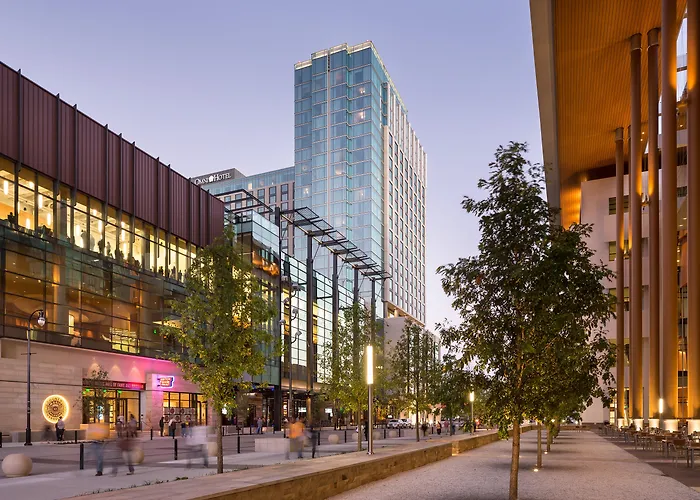
Across Martin Plaza are the complementary metal-clad geometric forms of the Museum Residences, also designed by Studio Libeskind and Davis Partnership Architects. With retail space on the ground floor, a shared parking garage, and 56 luxury apartments on the top six floors, the building introduced high-end urban housing to the city’s cultural center. Behind the museum, between 13th and 14th avenues on Bannock Street, is the site for the Clyfford Still Museum, being designed by Allied Works Architecture in Portland, Oregon. The museum will house the works of Clyfford Still, the legendary American Abstract Expressionist artist.3
On the north side of 13th Avenue, the Denver Public Library, designed by Michael Graves, the cofounder of Postmodern architecture, and Klipp, the Denver-based architecture firm, opened to acclaim in 1995. The library, the largest between Los Angeles and Chicago, features towers, buttresses, and whimsical spaces for children that suggest the worlds of fantasy and classical literature.4
Framing Civic Center Park to the north is the Wellington E. Webb Municipal Building, completed in 2002. Designed by Tryba Architects and RNL Design, the 12-story LEED-Gold municipal office complex offers a model of sleek sustainable architecture in the city core. The central atrium spine of this civic landmark visually and symbolically connects the City and County Building and the central business district. The civic plaza at Colfax Avenue and 14th Street displays the municipal center’s theme engraved on the walls: “This is where we build the City.”5
Uniting and Delighting with Public Art
Public art, including some quirky and gigantic sculptures, is a common thread that unites the Civic Center Park/Golden Triangle area, thanks to a requirement that the city contribute 1 percent of the cost of major capital projects to public art.6
I See What You Mean depicts a big blue bear peering into a window at the Colorado Convention Center. The Big Sweep, a 35-foot broom and dustpan, Denver Monoliths, a 40-foot abstract sculpture, and the Scottish Angus Cow and Calf surround the Denver Art Museum.7
The Denver Public Library plaza displays the 16-ton Lao Tzu and The Yearling, a 21-foot red chair with a pony. At the Wellington E. Webb Municipal Building, the large granite sculpture Janus Head, with two heads facing east and west, reminds us the city must look to the past as well as the future.8


Comments