Central Platte Valley
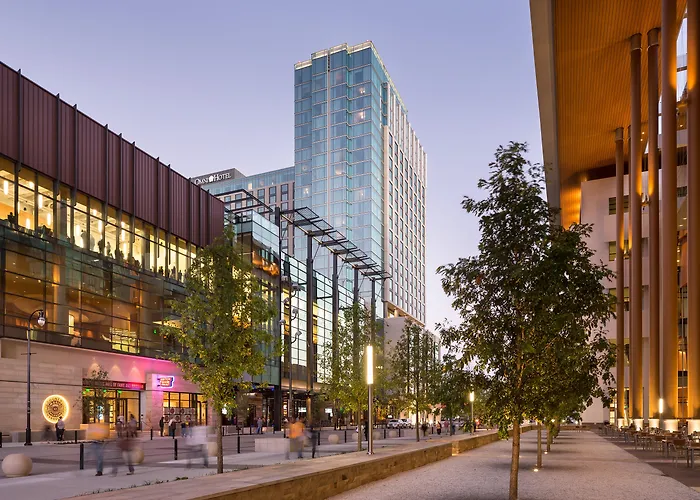
The inspired redevelopment of the Central Platte Valley is perhaps the model for Denver’s efforts to reinvigorate downtown. Recent redevelopment underscores Denver’s commitment to urbanism and reconnecting to the South Platte River. On any given day, people can be seen walking or biking to work on the trails, playing in the riverfront parks, and enjoying the views from the cafés and plazas associated with new high-density mixed-use buildings. The success of the Central Platte Valley, the city’s birthplace, is evident in the way people use the area, talk about it, and identify it as the model for future growth.1
The centerpiece of the Central Platte Valley is a collection of public parks and plazas, with three new pedestrian bridges linking downtown to the valley and to the Highlands neighborhood over I-25 to the west. The valley landowner, Trillium Corporation, worked closely with the city, trading land for and contributing to the construction of a riverfront park, overseeing the development of an urban design master plan, and securing complementary zoning. The 1997 Commons (Riverfront Park) Master Plan and Design Standards and Guidelines, prepared by Design Workshop, paved the way for redevelopment in the valley. The focal point of the plan was Commons Park, designed by Civitas and completed in 1999 as Denver’s first major city park built in 50 years. Commons Park features 20 acres of open green space, numerous trails, and park benches.2
With a completed Commons Park and new mixed-use zoning in place, East West Partners in 1999 purchased much of the land and has led the valley’s redevelopment with Riverfront Park. The project transformed a 50-acre former rail yard into a 21-block mixed-use urban village, assembled around a multimodal transit center for light-rail, commuter rail, passenger trains, and buses. Riverfront Park’s residential lofts, condominiums, and mixed-use buildings, a blend of traditional and contemporary architecture designed by 4240 Architecture and the Urban Design Group, include Riverfront Tower, Promenade Lofts, One Riverfront Park, and The Park. The buildings were completed between 2002 and 2008.3
In addition to Commons Park, several new riverfront parks stretch one mile along the South Platte River. Confluence Park, where the South Platte and Cherry Creek meet, marks the spot where Denver was founded when gold was discovered in 1858. The park is the city’s activity hub for bicyclists, walkers, joggers, Frisbee players, kite flyers, and other recreational users. To the north, the Denver Skate Park, completed in 2002, is one of the most popular public skate parks in the nation. Further north are the ball fields and picnic spots of the City of Cuernavaca Park, offering valuable open space along the river.4
Connecting the valley over railroad tracks to the 16th Street Mall and downtown is the Millennium Bridge, a 130-foot-long, 80-footwide, cable-stayed pedestrian bridge with a 200-foot-tall “mast.” Designed by ArchitectureDenver and engineered by Ove Arup & Partners, the bridge is an iconic piece of civic architecture for the city and a landmark for the valley.5
Anchoring Confluence Park to the west, across the river’s kayak runs, is the Denver Flagship Recreational Equipment Incorporated (REI) cooperative store and restaurant. The historic 1901 Denver Tramway Power Company building, redeveloped in 2000, is recreation central for the region’s outdoor enthusiasts. Seattle-based Mithun Architects designed the renovation, and Denver landscape architects Wenk Associates designed the landscape.6
The city’s initial investment in public parks, plazas, and civic infrastructure led to a residential renaissance—with 1,500 new apartments and condominiums built since 2000 and another 2,000 planned. Pioneer residential redevelopment projects include the historic Flour Mill Lofts, the former Pride of the Rockies flour mill and the last remnant of a milling industry that flourished in the valley in the early 20th century. Designed by ShearsAdkins with John Williams Architects, the lofts were developed in 1998 by Denver preservationist Dana Crawford.7
ShearsAdkins and Oz Architecture designed Waterside Lofts, located at Wewatta Street and Cherry Creek. Completed in 2002, the lofts began to establish new residential uses while providing pedestrian activity along Cherry Creek.8
Around the corner, at 15th and Delgany, is the LEED-Gold Museum of Contemporary Art (MCA), designed by renowned architect David Adjaye and completed in 2006 as the first cultural building in Riverfront Park. The museum block includes the luxury Art House Lofts, whose glass and metal-sheathed cubes complement the MCA’s angular façade with a contemporary architectural character and a series of small pedestrian-friendly spaces. Continuum Partners and Urban Ventures collaborated with the museum on its master plan and codeveloped the Art House Lofts. Urban Ventures also developed the Monarch Mills Lofts next door, with 56 affordable and 13 market-rate lofts. Studio Completiva designed the Art House and Monarch Mills lofts.9


Comments